

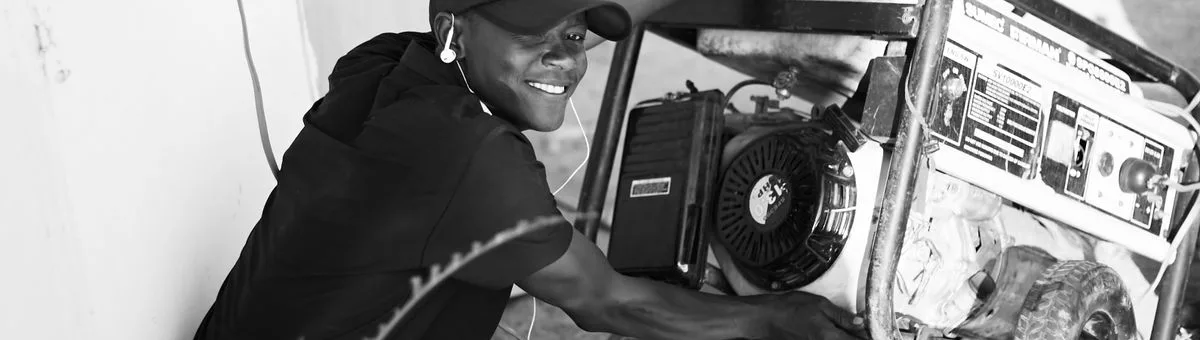
Generac GP8000E Quick Specs
| Running Power | 8,000W |
| Starting Power | 10,000W |
| Engine | Generac OHV (proven industrial reliability) |
| Electric Start | Yes (battery included) |
| Fuel Tank | 7.9 gallons |
| Runtime @ 50% Load | ~12 hours |
| Noise Level | ~78 dB at 1/4 load |
| Weight | 184 lbs |
| Outlets | GFCI outlets with circuit breaker protection |
| Price Range | $800–$1,000 |
Why the Generac GP8000E Stands Out
Generac's 60+ Year Legacy of Reliability
Generac isn't just a brand — it's a promise. For six decades, Generac has been the go-to choice for homeowners, contractors, and emergency responders. The GP8000E inherits that DNA: a proven OHV engine design tested in millions of installations worldwide. The track record speaks louder than any marketing claim.
When the lights go out during a hurricane or ice storm, thousands of homeowners across America fire up a Generac and assume it will start. That trust didn't happen by accident. Generac got into the backup power business in the 1960s when most portable generators were unreliable toys that sat in garages collecting dust. Generac focused on making generators that would actually run when you needed them, with engines that would last 10+ years of periodic use. That philosophy persists today — the GP8000E is engineered for reliability first, price second. The OHV (overhead valve) engine architecture is the same design that powers standby generators protecting hospitals, data centers, and critical infrastructure nationwide. The GP8000E is a mobile version of that industrial-grade reliability.
8,000W Continuous Power: What Can You Run?
The 8,000W running capacity is the workhorse specification. Here's what you can realistically power simultaneously:
- Whole-home essentials: Refrigerator (800W) + furnace (3,000W) + well pump (1,500W) + lights (300W) = 5,600W total
- Emergency backup scenario: Sump pump (1,500W) + basement lighting (200W) + CPAP machine (100W) + refrigerator (800W) = 2,600W total
- Job site power: Table saw (1,500W) + air compressor (2,000W) + work lights (500W) + chargers (300W) = 4,300W total
- What you CAN'T run together: Central AC (5,000W startup) + electric water heater (4,500W) = 9,500W exceeds capacity
The key word here is continuous. The GP8000E's 10,000W starting power handles the brief current spike when motors kick on (like your furnace fan). Once the motor is spinning, it drops back to running power — usually 40–60% of starting power. For a furnace fan, that's 1,200–1,500W running, much lower than the 3,000W startup surge. This is why you can run simultaneous loads that individually exceed 8,000W in starting power alone: the loads don't all surge at once.
The practical takeaway: list your essential must-run devices, look up their running wattage (not starting), and add them up. If the total is under 8,000W, you're golden. If you're at 7,500W–8,200W, you're in the red zone — you'll overload the generator if multiple motors start at the same moment. Plan your critical loads carefully, or upgrade to 10,000W+ capacity.
Runtime also matters. At full 8,000W load (a sustained, unusual scenario), you get about 6 hours. At 50% load (4,000W — your typical backup scenario), you stretch that to 12 hours. This is why the GP8000E is sized perfectly for essential home backup: it runs your critical circuits for a full night and into the next day without refueling.
Electric Start: No More Recoil Cord Struggles
The GP8000E comes with electric start and a pre-installed battery. Turn the key, and it fires instantly. No yanking a cord in the dark during an outage. No struggle in cold weather. The battery is one less thing you need to source separately, and it's covered under warranty.
This is a bigger deal than it sounds, especially for whole-home backup scenarios. Imagine it's 2 AM, the grid went down two hours ago, and your house is getting cold. You're groggy, maybe panicked, and now you have to stumble outside in the dark and wrestle with a recoil cord while wearing gloves. The electric start eliminates that frustration. Click the key, and the generator fires. You're back to running your furnace within 10 seconds. For RV camping or job sites, it's equally convenient — no rope burns, no wondering if you're pulling the cord correctly.
The included battery is a 12V unit that lasts typically 3–5 years with proper care (store the generator in a climate-controlled space during off-season, use a battery tender if you're storing for more than a month). When the battery does age out, replacements are cheap ($30–$60) and widely available. Many owners simply swap in a new battery every 4 years as preventive maintenance — a small cost for the convenience gained.
12-Hour Runtime on a Single Tank
With a 7.9-gallon tank and ~12 hours of runtime at 50% load, you can run essential systems overnight without refueling. During extended outages, this means fewer interruptions and greater peace of mind. You're not constantly watching fuel levels or worrying about running out mid-night.
Let's unpack that math. The GP8000E burns approximately 0.6–0.75 gallons per hour at 50% load (around 4,000W). Over 12 hours, that's 7.2–9.0 gallons — nearly the full 7.9-gallon tank. At full 8,000W load, fuel consumption jumps to 1.3 gallons/hour, cutting runtime to about 6 hours. For most homeowners, 50% load is the realistic scenario: your furnace is running intermittently (cycles on/off as temperature drops), your refrigerator is on steady, lights and a few chargers are drawing power, but you're not simultaneously running power tools or major appliances. This 50% load state is where the 12-hour runtime claim is accurate and useful.
The practical benefit: during a winter storm outage, you can run your generator overnight (8 PM to 8 AM), then shut it down while the power company restores service or while you decide your next move. If the outage extends into the next evening, you've had daylight hours to refuel (from a jerry can stored in your garage) or plan a fuel run to a local gas station. You're not scrambling for fuel at midnight with no gas stations open. For extended multi-day outages, keep 2–3 jerry cans of fuel on hand ($15–$30 investment) so you can refuel without leaving your home unattended.
Transfer Switch Compatible
The GP8000E is fully compatible with automatic transfer switches. A professional electrician can install the generator permanently outside your home, and it will automatically kick in when main power fails — no extension cords, no manual setup. This is the gold standard for whole-home backup.
Here's how it works: your electrician connects the GP8000E to an automatic transfer switch (ATS) installed in your breaker panel. The ATS continuously monitors grid voltage. The instant the power drops, the ATS disconnects your home from the grid and connects it to the generator — all in milliseconds. Your lights flicker once, and suddenly you're running on generator power. When grid power returns, the ATS waits 5 seconds (to confirm it's stable), then switches back. You might not even notice the transition if you're upstairs.
This setup costs $1,200–$2,500 for the transfer switch hardware and electrician labor, but it's the difference between manual startup heroics and silent, automatic protection. You don't have to run to your generator in the cold, don't have to connect cords, and don't have to think about it. For homeowners prioritizing peace of mind over cost, this is the standard installation. The GP8000E's 8,000W capacity handles a typical whole-home backup panel (30–50 amps) covering essential circuits. Your electrician will help you identify which circuits (furnace, refrigerator, well pump, lighting) get transferred, and which (AC, water heater, dryer) are left on the grid side.
Sizing Your Backup Power: Is 8,000W Enough?
Essential vs. Optional Loads
Before buying, create an inventory of loads you need during an outage. Essentials (must-have): furnace, refrigerator, water pump, sump pump, lighting, medical devices. Optional (nice-to-have): dishwasher, electric clothes dryer, water heater, air conditioning. The GP8000E handles all essentials; you'll need to skip non-essentials or run them sequentially.
Calculating Your Wattage Requirement
Add up the running wattage (not starting wattage) of devices you'll run simultaneously. Don't forget baseline draw from items on standby. If your total is 6,000W or less, the GP8000E will serve you well. If you're pushing 7,500W+, consider the larger DuroMax XP10000EH or Westinghouse WGen12000DF.
When 8,000W Isn't Enough
If you have a central AC unit (5,000W+), an electric water heater (4,500W+), or a large well pump (3,000W+), and you want to run multiple of these simultaneously, upgrade to a 12,000W+ generator. The GP8000E is realistic for essential backup only.
Generator Safety: Best Practices for the GP8000E
Carbon Monoxide: The Invisible Killer
Generator exhaust contains carbon monoxide. Never operate the GP8000E indoors, in basements, garages, crawlspaces, or enclosed sheds — CO seeps through walls and cracks and kills silently. Always run it outdoors, at least 20 feet from windows, doors, and air intakes. Point the exhaust away from your home and neighbors' homes.
Placement and Stability
Place the generator on level, dry ground. Check that it's stable before starting. Keep it away from rain, puddles, and high moisture areas. Never place it directly against a wall — ensure 3+ feet of clearance for airflow and cooling. Use a weatherproof cover if it rains, but remove it when running to prevent heat buildup.
Electrical Safety with Transfer Switches
If you install a transfer switch, hire a licensed electrician. Improper connections can backfeed power into the utility grid, electrocuting workers or damaging equipment. The transfer switch must have proper surge protection and grounding. Never try to backfeed through a simple extension cord — this is dangerous and illegal in most jurisdictions.
Fuel Handling and Storage
Always refuel outdoors, never while the engine is running or hot. Use a fuel stabilizer for any gasoline stored longer than 30 days. Drain the fuel system completely before off-season storage to prevent gum deposits in the carburetor — a gummed carb is the #1 reason generators won't start after winter storage.
Pros vs. Cons
Pros ✅
- Trusted brand: Generac's reputation means parts availability and resale value are excellent.
- Easy start: Electric start with included battery eliminates manual startup frustration.
- Good runtime: 12 hours at 50% load is solid for a generator this size.
- Compact for its power: 184 lbs is manageable for a single person with the wheel kit add-on.
- Excellent customer support: Generac's nationwide network of dealers and service centers.
- Transfer-switch ready: Designed for permanent whole-home installation.
Cons ❌
- Noise level: At ~78 dB, it's not silent. Neighbors will notice at night.
- No fuel stabilizer included: You'll need to add stabilizer for off-season storage.
- Requires regular maintenance: Oil changes every 50 hours, spark plug checks, seasonal fuel treatment.
- Higher price point: Generac charges a premium for the brand versus some competitors.
- No dual-fuel option: Limited to gasoline only, unlike the DuroMax or Westinghouse models.
Who Should Buy the Generac GP8000E?
Home Backup Power
If you live in an area with frequent storms or aging power grids, the GP8000E is designed for you. Its 8,000W capacity covers essential home circuits. With a transfer switch installation, it becomes your silent partner during outages — automatically powering critical systems without any action on your part. This is the primary use case for 85% of buyers.
Small Construction Sites & Job Runs
Contractors love the Generac brand because it's reliable, parts are everywhere, and resale value holds. The 8,000W capacity runs power tools, compressors, and work lights on residential job sites. It's portable enough to move between locations yet robust enough for daily commercial use.
RV Camping & Off-Grid Adventures
The 184 lb weight and 7.9-gallon tank make the GP8000E practical for RV trips. Run your AC for several hours, charge devices, and power small appliances without a massive generator footprint. The electric start makes it convenient for camp setup.
Generac GP8000E vs. Competitors
| Feature | Generac GP8000E | DuroMax XP10000EH | Westinghouse WGen12000DF |
|---|---|---|---|
| Running Power | 8,000W | 8,000W (gas) | 12,000W (gas) |
| Starting Power | 10,000W | 10,000W | 15,000W |
| Dual Fuel | No (gas only) | Yes | Yes |
| Electric Start | Yes (battery included) | Yes | Remote key fob |
| Weight | 184 lbs | 240 lbs | 389 lbs |
| Price | $800–$1,000 | $900–$1,100 | $1,200–$1,500 |
| Best For | Trusted reliability | Dual-fuel + value | Maximum power |
Generac GP8000E — 8,000W Electric Start Generator
- ✓ America's #1 generator brand — 60+ year track record
- ✓ Electric start with battery included
- ✓ Transfer-switch ready for whole-home backup
- ✓ 12h runtime at 50% load
Price on Amazon.com