

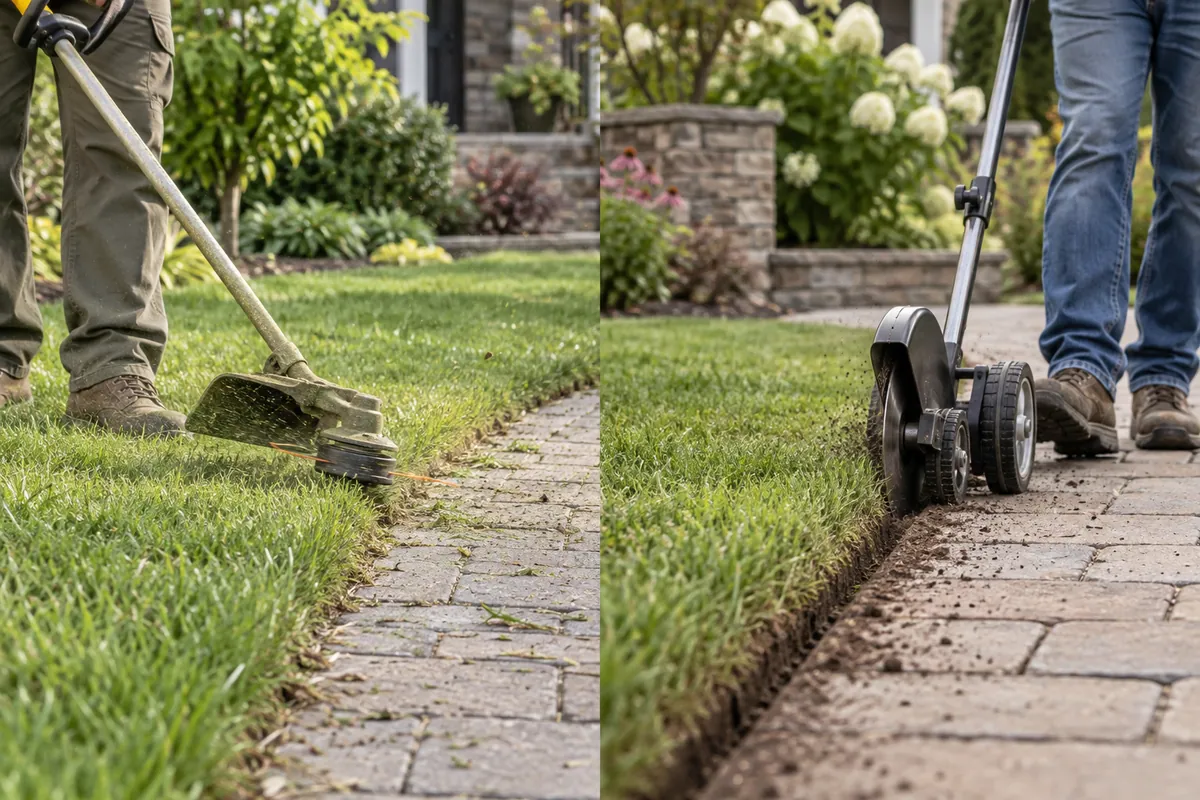
The key difference: trimming grass vs. defining an edge
A string trimmer is a finishing tool for grass the mower cannot reach. Its rotating line can follow irregular borders and work around trees, fence posts, and beds. A dedicated lawn edger is designed to create a more defined boundary; some designs guide a vertical blade along the edge, while the exact cutting head varies by model. Husqvarna describes the edger as a tool for creating edges and the grass trimmer as a tool for maintaining them.
The terms can overlap in product listings. Some string trimmers tilt or rotate their cutting head for edging; others accept an edger attachment, and some are intended only for trimming. Check the manual for the exact model and attachment before using a tool in a different orientation.
String trimmer vs. edger at a glance
| Question | String trimmer | Dedicated edger |
|---|---|---|
| Cutting action | Rotating line trims grass and weeds | Purpose-built head; some models use a guided vertical blade |
| Best fit | Irregular borders, around obstacles, mower finishing | Repeated, defined edges beside a hard surface or bed |
| Flexibility | Often more maneuverable for mixed trimming tasks | More specialized for edging |
| Before use | Check line type, guard, handle, and permitted orientation | Check blade condition, guard, depth setting, and manual |
These are tool roles, not performance ratings. A dedicated edger’s cut and setup vary by model; a trimmer’s ability to edge also depends on its design. Compare the manual and compatible accessories rather than assuming a universal attachment fit.
When a string trimmer is the right tool
Use a string trimmer for grass along uneven borders, around trees, beside fences, and in places the mower cannot reach. It can also help maintain an existing lawn edge where the manufacturer allows an edging position. Because the line can strike nearby surfaces and plants, work slowly around bark, stems, irrigation, and decorative stone.
For an irregular garden with mixed obstacles, one trimmer may cover several finishing tasks. Choose a model whose weight, handle position, line-feed system, and guard you can manage. Match replacement line and attachments to the owner’s manual; unapproved accessories can affect safe operation.
When a dedicated lawn edger is useful
A dedicated edger can make sense when you maintain long, repeated borders beside pavement or a formal bed and want a more consistent boundary. On models with a guide wheel and blade, these parts help follow a hard edge. Before buying, check whether the tool can adjust cutting depth, whether the edge is accessible without disturbing roots, and how the cutting head is inspected or replaced.
If your lawn has only short or irregular borders, the extra tool may have little use. A trimmer or a hand edging tool may suit occasional maintenance better. Consider how often the edge needs attention and whether you have room to store another powered tool.
A powered edger is not a remedy for every uneven border. Tree roots, edging stones, exposed irrigation, and steep ground can limit where a blade can safely travel. Walk the full edge before starting and decide where a hand tool or careful trimmer work is more appropriate.
Can a string trimmer edge a lawn?
Some models allow the trimmer head to be turned for edging. EGO, for example, says certain string trimmers can be used this way by turning the tool sideways and adjusting the auxiliary handle. That is model-specific guidance. Verify the exact product manual and use the guard and handle configuration required by the maker.
A compatible edger attachment is another option for some multi-head systems. Confirm the exact power-head and attachment model numbers before buying. A shared brand or battery platform does not prove that an attachment fits every tool.
Plan the border before trimming
First identify the boundary you want to maintain: a narrow line against paving, a curved lawn border, or grass around a tree. Remove loose objects and check for roots, cables, irrigation, stones, or edging that could be hit. If the edge is badly overgrown, mark the intended line and remove a small amount at a time so the shape is visible as you work.
For a clean line along a hard surface, use a dedicated edger or an approved edging setup and follow its depth and orientation instructions. For curved beds and obstacles, a string trimmer gives more freedom to follow the outline, but it can damage bark and soft stems. Keep the head clear of plants and make short, controlled passes.
Match the tool to the edge you need to maintain
| Border condition | Starting tool | Check before cutting |
|---|---|---|
| Irregular grass around beds or obstacles | String trimmer | Line type, guard, clearance from stems, bark, and irrigation. |
| Long, repeated boundary beside pavement | Dedicated edger or a trimmer setup the manual permits | Blade or line orientation, depth control, and the exact model instructions. |
| Old edge hidden by turf or roots | Hand-check the line, then use a suitable powered tool gradually | Buried services, roots, stones, edging material, and where debris will travel. |
For routine maintenance, remove only the grass that has crossed the boundary. If the work is taking repeated passes or producing an uneven cut, stop and reassess the tool type, line condition, or blade. Continuing to push the wrong tool harder can damage the edge or the equipment.
A clean edge is easier to maintain when the boundary is visible and the tool follows it consistently. Work in short sections and compare the cut with the line you marked instead of trying to remove a large strip in one pass. If the line is uneven because the lawn has grown over a hard surface, expose the original boundary carefully before using powered equipment. Avoid cutting blindly through soil where irrigation tubing, roots, or cables may be present.
After the first pass, stop and inspect the result from standing height. A small correction may be enough; repeated deep passes can widen the bare strip or disturb the bed. For a curved edge, use shorter movements to follow the shape. For a straight path, use the surface as a guide only when the tool’s manual permits that position and the cutting head can be controlled safely.
Check attachment and model compatibility
When comparing a trimmer with a multi-head system, verify each model number. Check the power head, shaft connection, attachment, battery or fuel system, guard, and included accessories. Read whether the attachment is sold separately, whether a battery and charger are included, and which cutting line or blade is approved.
A string trimmer that can be rotated for edging may need an adjustable auxiliary handle or a specific guard. A dedicated attachment can require a compatible power head and a different blade. Keep the product manual with the tool so you can confirm the setup each season, especially after replacing the cutting head or sharing equipment with someone else.
Operate safely and protect the cutting path
Before starting, inspect the cutting line or blade, guard, handle, and attachment for wear or damage. Clear stones, sticks, toys, and other debris from the work area. Keep people and pets away from the cutting path and follow the manual for eye and hearing protection. EGO’s ED0800 edger manual, for example, specifies eye protection meeting ANSI Z87.1 and hearing protection.
Stop the tool before clearing a blockage or changing an attachment. Remove the battery or disconnect the power source as the manual instructs. Do not remove a guard, improvise a blade, or use an attachment that the manufacturer does not approve for your model.