

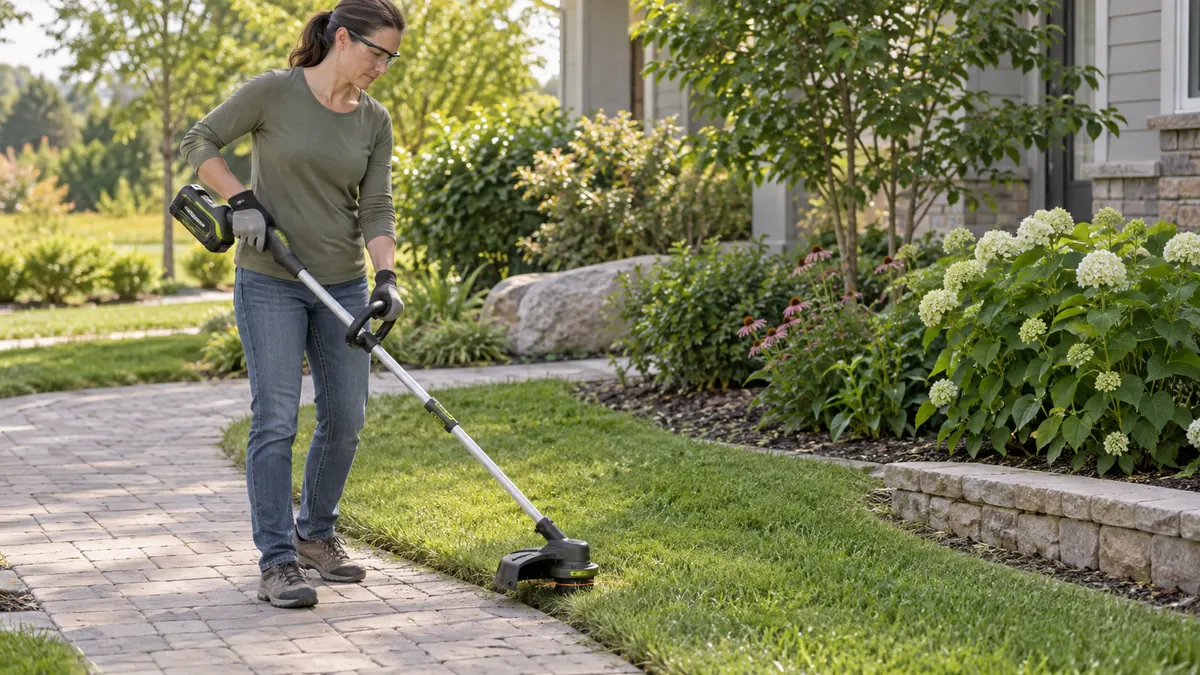
Three manufacturer battery-trimmer examples
- EGO ST1521S: 15-inch swath, .095-inch line, brushless motor, POWERLOAD and carbon-fiber split shaft; verify kit battery separately.
- RYOBI RY40250: adjustable 13–15-inch swath, 40V, attachment-capable; manufacturer marks it discontinued.
- CRAFTSMAN CMCST900D1: 13-inch cordless trimmer/edger kit with 2.0 Ah battery, according to CRAFTSMAN.
Compare the published model configurations
These manufacturer examples represent different battery systems and packages; they are not a controlled performance test. EGO's ST1521S page describes a 56 V, 15-inch trimmer with .095-inch dual-feed line, POWERLOAD and a split shaft. RYOBI's RY40250 page lists a 40 V tool with adjustable 13–15-inch swath and marks the model discontinued. CRAFTSMAN's CMCST900D1 is a 20 V, 13-inch trimmer/edger kit with a 2 Ah battery. Their head designs, pack sizes and service availability are not interchangeable.
| Model example | Published setup | Confirm before comparing |
|---|---|---|
| EGO ST1521S | 15 in, .095 in line, POWERLOAD, 56 V platform | Exact battery and charger in the chosen bundle |
| RYOBI RY40250 | 40 V, adjustable 13–15 in, attachment-capable | Model is discontinued; check parts and genuine stock |
| CRAFTSMAN CMCST900D1 | 20 V, 13 in, kit with 2 Ah battery according to maker | Other CMCST900 configurations may be tool-only |
Voltage labels are platform identifiers, not a direct measure of cutting ability between brands. The product-page claims also use different runtime conditions, so do not convert them into an apples-to-apples ranking.
Compare swath, line, feed and battery package
If the yard already uses a battery platform, compare tool-only and kit totals carefully. A wider swath can cut a wider path but may use more energy and line. Check line diameter and feed system, shaft adjustment, guard, weight, battery availability and compatible attachments. Runtime claims need battery and grass conditions; do not assume the manufacturer's “up to” figure matches dense weeds.
Choose the line system and battery
- Compare cutting swath, line diameter, head type and line-feed method from the exact model documentation.
- Check whether a battery and charger are included, or whether the listing is tool-only for an existing platform.
- Confirm guard, handle, harness and attachment compatibility against the manual for that exact trimmer.
- Consider vegetation, line replacement, charging and local parts or service availability.
Understand runtime claims and work pace
Battery runtime depends on the pack, speed setting, vegetation, line length, head resistance, temperature and how often the trigger is released. A maker's “up to” minutes usually represents a specified test configuration, not a guarantee for continuous dense weeds. Record the battery capacity and included model number when comparing packages, and look for runtime details tied to the exact pack.
Plan a work session in zones: trim a representative edge, check battery consumption and observe whether the line feeds correctly before starting the whole yard. If you need a second pack, add the charger and pack cost to the tool-only price. Consider the charging interval and whether another compatible tool already uses the same battery family. Don't assume packs from a different voltage generation fit because the physical shape looks similar.
A wide swath can reduce the number of passes on open ground, but it can increase resistance in thick grass and make precise trimming around garden beds harder. Variable speed lets the user slow down for delicate spots and use more output where grass is dense. Where a trimmer lists variable speed, check the model's trigger, lock and operating guidance rather than assuming every setting preserves the same runtime.
Check battery platform and replacement parts
Before selecting a kit, verify that the battery and charger are included and compatible with the exact model. The EGO page lists bare tools and several battery bundles within the same family; RYOBI lists both bare-tool and kit options on other models; CRAFTSMAN's CMCST900D1 page names a 2 Ah battery. Retailer bundles can use a different suffix from the manufacturer's bare tool.
Line heads are model-specific. EGO describes .095-inch dual-feed line for its cited 15-inch trimmer; CRAFTSMAN uses an automatic-feed system; RYOBI uses an adjustable swath and a 3-in-1 bump-feed head on a separate model line. Match line diameter, loading method and approved head to the manual. If a replacement head is unavailable, do not assume another platform's head will fit.
Attachment-capable shafts add flexibility but only with listed attachments and the correct coupling. Compare the manufacturer's compatibility list and the required guards. A string-trimmer head is not automatically approved for a blade, edger or pole-saw attachment.
Match the tool to the yard and vegetation
A small fenced lawn with a few edges may favor a lighter 13-inch tool and a smaller battery. Long boundaries and open areas may benefit from a wider swath, a shoulder-friendly harness or a second battery. If thick brush, saplings or large unmanaged areas are part of the job, a string trimmer may be the wrong machine; review a brush cutter with the correct blade and guarding, or clear the vegetation with an appropriate tool.
Consider posture before purchase. Shaft length, adjustable handle position, head angle, battery location and total loaded weight influence fatigue. Try the complete tool, including battery and guard, if possible. Keep the line head parallel to the ground for ordinary trimming, avoid forcing the line into trunks or masonry and take breaks if vibration or weight reduces control.
No delivery-based recommendation
The Amazon identities previously checked matched the named EGO, RYOBI and CRAFTSMAN products, but none shipped to the selected delivery destination. No affiliate box is retained without confirmed deliverability for the market audience.
Keep the cutting head and bystanders clear
Follow each manual for guards, line, battery removal and PPE. Keep people and glass clear of the cutting path, wear eye protection and long trousers, and stop the head before clearing wrapped grass.
Remove the battery before winding line, clearing vegetation or checking a stuck head. Inspect the guard and line-cutting blade before each session, and use the line type specified by the manufacturer. Direct debris away from people, vehicles and windows, and do not use an unapproved metal blade on a line-only trimmer.
Runtime depends on more than battery capacity. The species and height of vegetation, line diameter, swath, head design, operator pace and how often the motor reaches full load all affect use time. Manufacturer runtime claims often use a defined test setting; they are not a guarantee for continuous cutting in thick grass. For a long perimeter, consider a spare compatible battery and leave room in the budget for the charger.
Confirm the exact kit suffix and platform before ordering. A bare tool may include no battery or charger, and a pack with the same nominal voltage may use a different interface or generation. Read the tool manual and battery compatibility list. A larger battery can extend work but adds weight at the rear or on a harness; balance and handling matter during repeated edging.
Use the line diameter specified for the head and replace it with the correct shape and feed mechanism. Bump-feed heads advance line only by the approved method; auto-feed heads may use a different spool. Do not install a metal blade unless the tool, guard and manual list it. Keep the plant crown, bark, fencing and stone walls clear of line, which can damage both the plant and the tool.
Charge and store battery packs according to the maker’s manual, away from moisture and heat. Remove the pack before clearing wrapped grass or checking the head. Clean vents and contacts without spraying the tool with water; stop if a battery is swollen, unusually hot or damaged. Choose a corded trimmer if a protected outlet and short work path fit better, or a gas brush cutter for heavier vegetation within its rated purpose.
Match cutting swath to access rather than assuming a wider head is always better. A broad swath may cover open lawn edges quickly, while narrow beds, raised planters and winding paths demand control and a shorter pass. Line must remain inside the guard’s permitted length. Too much exposed line increases load and can strike trunks, walls, fences and glazing.
For a used tool, inspect the battery latch, guard, head, trigger and charger. Check for a clear model number and determine whether the seller includes a battery of the capacity used in the manufacturer’s runtime claim. A tool-only listing can look inexpensive until the platform pack and charger are added. Confirm the replacement spool and line are available before purchase, especially for a less common head.
Use a head designed for the vegetation. A string trimmer handles grass and fine soft growth; it is not a brush cutter unless the manufacturer explicitly rates the tool, guard and head for an approved blade. Do not attach a blade to a string-only model. For woody stems, switch to loppers, a pruning saw or a brush cutter appropriate to the job.