

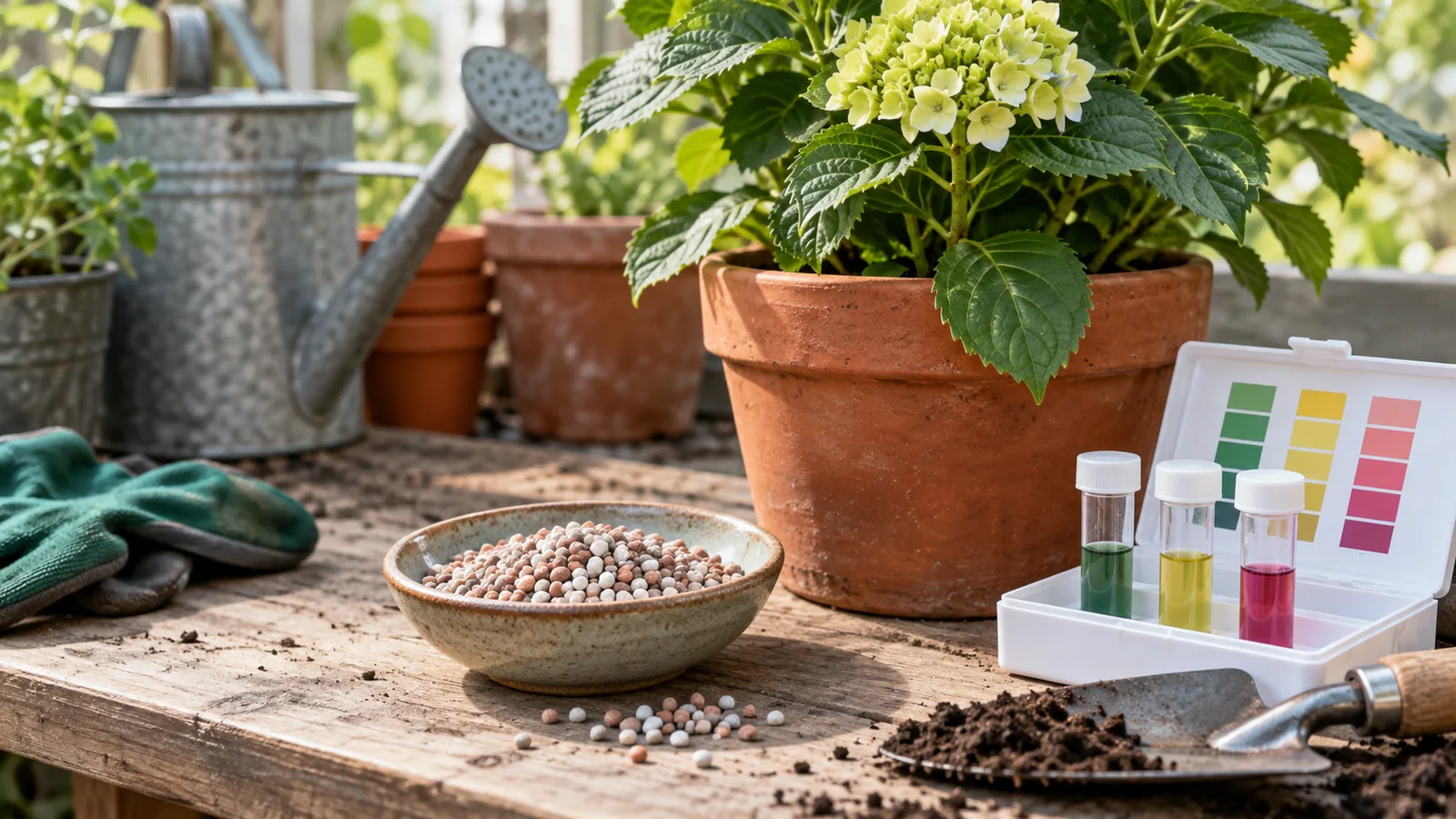
What fertilizer analysis N-P-K means
On a U.S. fertilizer label, three numbers describe the guaranteed analysis: percentage by weight of nitrogen (N), available phosphate expressed as P2O5, and soluble potash expressed as K2O. They are not a complete recipe for every plant, and the last two figures are oxide equivalents rather than elemental phosphorus and potassium.
For example, a 10-10-10 product lists 10% of each of those labeled components by weight. The label also states other ingredients, use directions and cautions. Oregon State Extension explains how to read fertilizer labels.
Nitrogen: apply only when a crop or test calls for it
Nitrogen is part of plant proteins and chlorophyll and supports vegetative growth. Too little and too much can both cause problems; pale leaves are not enough to diagnose deficiency. Use soil-test or crop-specific guidance and follow the label’s rate, timing and application method.
Phosphate: avoid unneeded applications
Fertilizer labels express phosphorus as available phosphate (P2O5). Phosphorus supports energy transfer and root development, but adding it does not automatically improve flowering or transplant success. Test first and observe local phosphorus rules to reduce runoff risk.
Potash: use the label and soil test
The third label number expresses soluble potash as K2O. Potassium supports multiple plant functions, but the appropriate amount depends on soil, crop and local recommendations. A balanced fertilizer is not automatically appropriate for every garden.
Read the entire fertilizer label
- Check the guaranteed analysis and fertilizer type, including slow- or controlled-release claims.
- Read the target crop, site and application directions.
- Calculate the amount from the label rather than guessing by color or plant size.
- Keep fertilizer off leaves or waterways when the label advises, and store it safely.
- Follow local nutrient and phosphorus restrictions.
Label release duration and nutrient availability vary by formulation. Do not generalize one product’s duration to all fertilizers.
Separate the fertilizer grade from its nutrient ratio
The fertilizer grade is the three-number analysis printed on the package. The nutrient ratio is the relative proportion of those three numbers after reducing them. A 10-10-10 grade has a 1:1:1 ratio; a 24-8-16 grade has a 3:1:2 ratio. Two products can therefore have the same ratio but different nutrient concentrations and application directions.
Ratios are useful for comparing the relative balance of N, phosphate and potash, but they do not tell you how much fertilizer to apply. That amount comes from a crop or soil-test recommendation and the label. A high first number does not mean a product is the best choice for leafy plants, and a high middle number does not automatically encourage flowering. More is not better: excess soluble fertilizer can injure roots, raise soil salts and increase nutrient movement into runoff.
Oregon State Extension’s fertilizer-label guide explains how the analysis is expressed. Penn State Extension’s example on matching fertilizer to recommendations shows why a product’s ratio and the requested nutrient amount need to be considered together.
Choose nutrients from the crop and soil result
There is no universal N-P-K formula for lawns, vegetables, flowering plants or transplants. Use soil-test recommendations, local Extension guidance and the product label. Consider existing nutrients in compost or other amendments, and avoid applying extra phosphorus or nitrogen without a documented need.
Oregon State Extension’s fertilizer guide explains label analysis and how recommendations relate to the site.
Choose a formula only after identifying the crop and reading the full recommendation. Many labs provide a nutrient rate rather than a brand or bag number. If the report recommends nitrogen but no phosphorus, a product with a high middle number can add unnecessary phosphorus. In parts of the United States, state or local laws restrict phosphorus lawn fertilizer unless a soil test or establishment exception applies. Check current local requirements rather than assuming the same rule applies everywhere.
Compost and manure can contribute nutrients but their analysis varies. Include their past use in your soil history, particularly where a test shows phosphorus or potassium already high. Organic labels do not remove the need to follow application rates, and concentrated liquid products still require accurate dilution. A plant’s yellow leaves, slow growth or sparse flowering alone cannot tell you which NPK formula to buy.
Calculate the labeled nutrient amount
The calculation begins with the application rate from the recommendation, not with the bag. For example, a 10-pound bag of 10-10-10 contains one pound of labeled nitrogen, one pound of available phosphate and one pound of soluble potash, with the remaining weight made up of other material. This does not mean that one pound of the whole product is appropriate for a particular bed; the crop-specific recommendation sets the rate.
If a soil report recommends a particular mass of a nutrient form, divide that recommendation by the percentage on the label written as a decimal to estimate the amount of fertilizer needed. For instance, meeting a hypothetical 0.5-pound nitrogen recommendation with a 10% nitrogen product would require 5 pounds of that product for the same area: 0.5 ÷ 0.10 = 5. Do not use this example as a garden rate. Confirm that units, area and nutrient form match the lab report, and account for the other nutrients that the product will add.
When a fertilizer’s proportions do not match the report, applying enough to satisfy one nutrient can overapply another. Use a different grade, a single-nutrient product or a professional/local Extension recommendation if the label math does not fit. Penn State’s worked examples for tailoring a fertilizer explain the calculation and the tradeoff of choosing one product over another.
Secondary nutrients and micronutrients
Calcium, magnesium, sulfur and micronutrients are needed in different amounts by different plants. Their presence in a fertilizer does not mean the soil needs them. Test, diagnose and follow a crop-specific recommendation; over-applying micronutrients can also injure plants.
Apply fertilizer without wasting or overapplying it
Measure the bed or lawn area before applying product. Calibrate a spreader according to its instructions and do not fill it over pavement where spilled granules can reach a storm drain. Sweep granules from sidewalks and driveways back onto the treated area if the product label allows. Avoid applying before heavy rain or to frozen, saturated or waterlogged soil when runoff is likely.
Keep fertilizer in its original labeled container, dry and secured from children and pets. Wear any protective equipment listed on the label, wash hands after handling and do not reuse a measuring cup for food. For liquid concentrates, mix only the amount and concentration shown in the directions. Never combine products unless the label explicitly allows it.
After applying, observe the plant and retain the package information. If symptoms worsen, do not immediately add another fertilizer. Check for water stress, salt injury, root problems, pests and application errors, then contact your local Extension office with the product label and soil-test result. The N-P-K numbers help interpret a product; safe, useful application still depends on measurement, timing and the site.
Translate the NPK label into a measured application
Use the recommendation and label together. A soil-test report may state a nutrient need per area, while the bag lists a guaranteed grade by weight. Those values are not interchangeable until you calculate how much product delivers the recommended amount. For example, if a local recommendation calls for a measured quantity of nitrogen, divide that nutrient requirement by the nitrogen fraction on the label to estimate product weight, then verify the area, timing and maximum rate on the product directions. Do not use this example to set a rate for a lawn or crop without a local recommendation.
For a small garden bed, measure the planted area rather than estimating from the entire yard. Mark the length and width, convert units if the report uses a different system, and split the total amount into evenly measured portions. A calibrated spreader can improve distribution over a lawn; for a small bed, a scale and careful hand application may be more appropriate. Keep fertilizer off leaves and stems unless the product specifically allows foliar use, sweep granules from pavement and keep them out of drains.
Product form changes how and where nutrients are released, but it does not remove the need to follow directions. Granular products may be quick- or slow-release; liquid concentrates need accurate dilution; organic products still contain nutrients and can be overapplied. Compare guaranteed analysis, release type, permitted site and the application instructions rather than relying only on words such as “starter,” “complete” or “natural.” Penn State Extension’s fertilizer calculation guidance shows how to match available grades to a recommendation.
Account for nutrients already present in compost, manure, irrigation water or previous applications when a soil report or local guide asks you to do so. Repeated phosphorus-containing fertilizer may be unnecessary in some soils and is restricted in some jurisdictions. Check state or county rules before applying lawn fertilizer, particularly near water. Never fertilize frozen, saturated or paved surfaces where material can move in runoff, and follow label limits around wells, waterways and storm drains.
Store the container in its original packaging in a dry, secure place, and keep it away from food, feed, children and pets as directed on the label. Clean measuring tools and spreaders after use, but prevent rinse water from reaching storm drains. Record the product, grade, amount, date, area and soil-test recommendation; this prevents accidental double application and makes the next decision easier. If the label and soil report appear to conflict, pause and ask the lab, Extension office or manufacturer before spreading.
NPK explains the primary nutrient grade, not every feature that determines fertilizer performance. Secondary nutrients, micronutrients, soil pH, crop demand, weather and root health remain part of the decision. Oregon State Extension’s fertilizer guide and local recommendations can help explain those differences without treating one ratio as best for every plant.
Compare NPK grades without overapplying fertilizer
Two fertilizer grades can supply the same amount of nitrogen at different product weights. In a hypothetical calculation, a product with 10% nitrogen supplies 1 pound of nitrogen in 10 pounds of product; a product with 5% nitrogen supplies the same pound in 20 pounds. This illustrates the math only. It is not a recommendation to apply either amount to a garden or lawn. Use the rate from a soil test or crop-specific Extension recommendation, and verify that the label permits use on the site.
Compare products using the nutrient the recommendation actually names. If a report recommends phosphorus or potassium, match the local units and the fertilizer label’s listed phosphate or potash form carefully. Do not compare the first number alone when a crop-specific recommendation concerns another nutrient. If the product ratio does not align with the report, ask Extension or the lab for help selecting a product rather than compensating with a guessed quantity.
For a blended fertilizer, calculate only after measuring the area and checking the bag’s coverage directions. A product may provide enough of one nutrient while supplying more of another than the soil needs. Repeated applications can accumulate nutrients or salts. Keep the product label, soil report and application record together so you can compare the next season’s results.
Also compare the application method. A lawn spreader requires the correct setting and an even walking pattern; a small bed may be treated more accurately with a measured amount distributed by hand according to the label. Calibrate equipment with a safe test if the directions recommend it, then sweep material from sidewalks and driveways. Do not apply before heavy rain or over saturated soil, and protect waterways and drains from runoff.
Fertilizer labels and restrictions can vary by state, product and year. Check your local rules for phosphorus, lawn timing, buffer areas and disposal. If a label is damaged, incomplete or does not list your intended crop or site, do not guess. Contact the manufacturer or a local Extension office for clarification. Oregon State’s guide to understanding fertilizers explains grades and nutrient forms; local recommendations determine which product and rate suit your soil.
Frequently Asked Questions
Use the N-P-K label to compare products, not to decide whether your soil needs fertilizer. The three numbers are the guaranteed percentages by weight of nitrogen, phosphate (P2O5) and potash (K2O); a 10-pound 10-10-10 bag contains one pound of each labeled nutrient form. What to apply depends on crop, soil test, local guidance and the product label. See OSU Extension’s fertilizer guide and UMN’s soil-testing advice.