

Check the UV claim and warranty for the exact model
Outdoor durability depends on material, pigments, exposure, climate and installation. Do not infer a fixed lifespan from the words “UV-resistant” or “weatherproof.” Ask for the exact model’s UV test method, warranty period, exclusions, cleaning instructions and temperature limits.
Place the item where it will be secured against wind, and check drainage and pot weight if it is installed in a planter. A warranty is only meaningful when its terms match the intended use.
Use manufacturer pages as model-specific evidence, not independent testing. For example, Nearly Natural labels selected products in its current outdoor collection as UV resistant and says outdoor pieces may need additional cleaning after rain and pollen. That wording does not establish a universal service life or cover every plant in the category. Open the exact product page and confirm the material, intended exposure, warranty period and exclusions before buying.
Choose by exposure and secure installation
Balconies, patios and entrances expose items to different sun, wind and rain. Compare dimensions, mounting or weighting instructions, cleaning needs and applicable warranty for the exact item. On balconies, secure lightweight pieces so wind cannot dislodge them and confirm any building rules before attaching screens or planters.
This page does not rank tested products. It provides criteria for checking a model’s specifications.
Topiary shapes: inspect material and construction
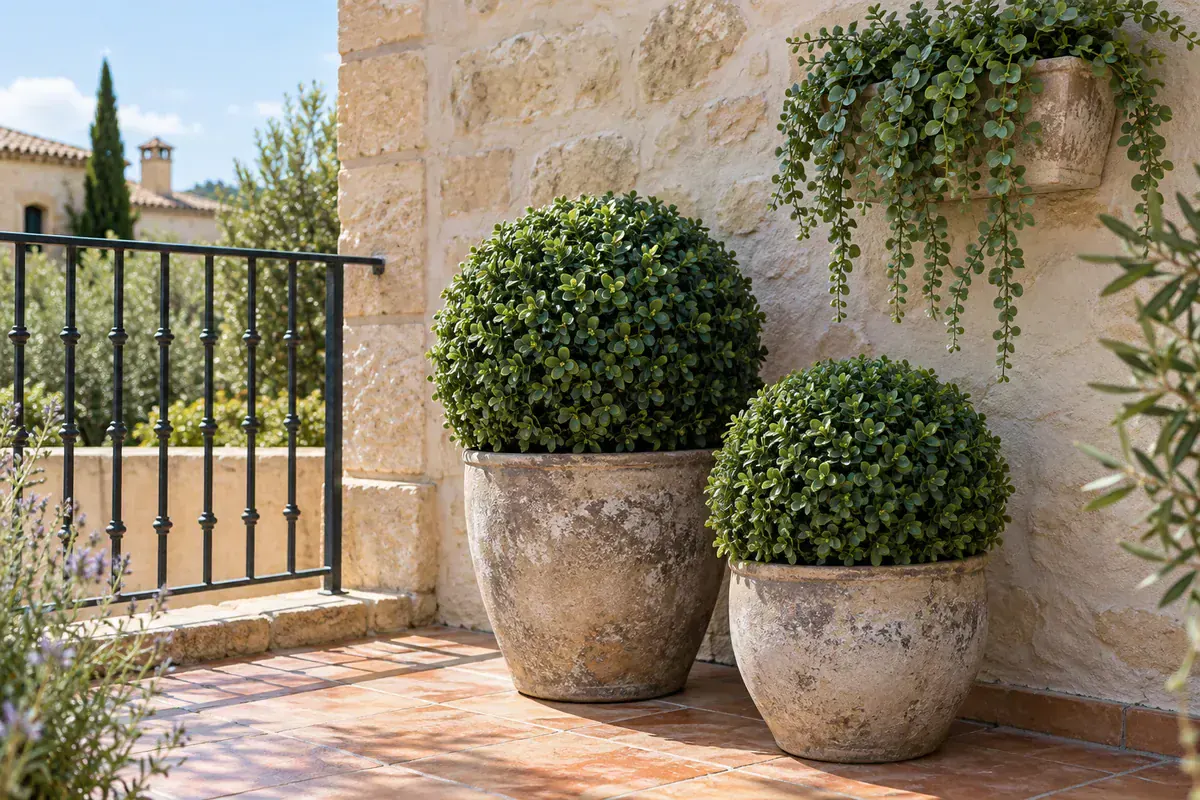
Artificial boxwood and topiary are sold in different materials and construction styles. Inspect the exact product for foliage material, frame, UV documentation, dimensions, attachment method, cleaning and warranty. Photos alone do not establish durability or appearance at the intended viewing distance.
Screens and panels: verify fastening and wind load
Artificial hedge panels and grass screens can catch wind. Check the manufacturer’s fixing method, panel dimensions, intended exposure and whether the supporting fence or railing can handle the load. Confirm fire and building requirements for the location before installation.
Store or clean according to the product documentation
Outdoor care depends on the material and warranty. Remove debris using the maker’s instructions; avoid solvents, pressure washing or winter storage unless the documentation permits them. Secure items before storms and inspect fixings, seams and discoloration over time.
“All-weather” does not establish resistance to every climate or exposure.
Compare verified model details, not broad labels
| Detail | What to verify |
|---|---|
| Use | Indoor/outdoor rating and intended exposure |
| Material | Foliage, backing, frame and stated test documentation |
| Installation | Dimensions, fixing points, weight and wind exposure |
| Aftercare | Cleaning instructions, warranty exclusions and storage |
No product-by-product comparison is included because a verified set of current models and comparable specifications is not available in this guide.
Review exposure and fixings after installation
Inspect the arrangement after its first period of sun, wind or rain and after severe weather. Look for loose ties, panels separating from a fence, branches bending, water trapped in a planter and early color change. If the item shifts, take it down until the fixing method is corrected. A product marketed for outdoor use may still have exposure limits or a warranty that excludes direct sun, coastal conditions, freezing weather or storm damage.
Record the model, purchase date, location and care instructions so that you can compare any change with the product warranty. Photograph the installation and the relevant specification page. This is useful for a claim, but it does not prove that a product was tested for a particular climate. If you cannot verify performance details, choose a design that can be brought indoors or replaced without leaving exposed fixings behind.
Think about the full life of the display as well as its initial appearance. Artificial foliage combines materials such as plastics, wire, fabric, coatings and adhesives; recycling options may depend on local facilities and product construction. Avoid unsupported “green” or “eco-friendly” descriptions. The FTC’s environmental claims guidance recommends specific, substantiated claims rather than broad labels. Clean only as permitted by the maker and store seasonal pieces dry and protected from unnecessary sun.
Keep a maintenance record for outdoor displays
For a display exposed to weather, keep a note of the product reference, installation date, location, care instructions and warranty conditions. Photograph the installation and its fixings before the first season. If branches or panels later loosen or fade, the record helps you compare what happened with the maker’s documented limits; it does not prove that a product was tested for every climate.
Assign an inspection schedule based on the exposure and installation. Check after strong winds, storms, freeze events and any work on the railing or fence. Look for loose anchors, cracked pots, corrosion on metal fixings, separated seams and water trapped around the base. Remove a damaged piece until it can be safely repaired or replaced.
When cleaning, follow the maker’s method and avoid pressure washing, bleach or solvents unless the exact product documentation permits them. Cleaning products can affect pigments, coatings and adhesives. If dirt cannot be removed safely, contact the manufacturer rather than testing a new chemical on the entire display.
Plan storage or replacement before the product fails. A seasonal piece may be easier to protect if it can be taken down and stored dry; a fixed panel requires secure hardware and access for inspection. Consider the costs of the container, supports, installation, cleaning and disposal alongside the purchase price. There is no universal cost or environmental advantage for every artificial display.
Keep product details for an outdoor display
For every piece exposed outdoors, retain the exact model name, dimensions, material description, purchase date, installation method and written care instructions. If the maker gives a UV test, warranty or temperature limit, save the document and note which components it covers. A general statement on a category page may not apply to the specific size or finish you installed.
Set a recurring visual check after storms and at the start of each season. Look for fading, brittleness, loose ties, water trapped in a planter and any mounting that has shifted. Compare the condition with the manufacturer’s guidance before cleaning or applying a coating. Do not add paint, sealant or adhesive unless the maker confirms it is compatible; an improvised treatment can affect the surface or warranty.
When the display reaches the end of its useful life, separate components only if you can do so safely and local waste guidance allows it. Mixed materials may need to go through a different route from a single-resin item. Ask the local authority or the manufacturer about collection and replacement options rather than making a broad recyclability assumption.
Frequently asked questions
Compare a specific specimen and its written specification. Ask the seller for the exact material, dimensions, UV-resistance evidence, warranty exclusions, drainage or pot-weight details, and cleaning instructions. “Outdoor,” “fade-proof” and “maintenance-free” are not interchangeable guarantees; check what the warranty actually covers and for how long. Because this page has no verified model-by-model comparison, use its criteria as a checklist and do not interpret it as a product ranking. The FTC Green Guides summary also explains why broad environmental claims require substantiation.
Inspect an outdoor artificial display after weather changes
Outdoor exposure is a combination of sunlight, rain, wind, temperature and the way the item is installed. A label saying “UV resistant” does not show how long colour or flexibility will last, what test was used or whether the claim covers every component. Ask for the exact model’s written specification, warranty period and exclusions, then check whether the intended placement falls within them. Treat photos and category descriptions as inspiration, not proof of performance.
Plan anchoring for the site. A lightweight pot or screen may move in gusts, while a heavy decorative base may be difficult to relocate for cleaning. Use the manufacturer’s installation method and check the mount periodically for looseness, wear and corrosion. Do not attach a panel to a fence, balcony rail or building element unless that structure and fixing are appropriate for the added load. If wind exposure or attachment strength is uncertain, consult a qualified installer.
After storms or seasonal temperature changes, inspect ties, joints, coatings, drainage and any exposed wire. Remove accumulated debris and clean using only the method recommended for the product. If pieces become brittle, shed material or detach, stop using the display until it can be repaired or secured. Keep children and pets away from damaged edges or loose parts.
Plan for eventual disposal as well as installation. Artificial foliage can combine plastic, wire, fabric, coatings, adhesives and pots, and local recycling facilities may not accept a mixed assembly. Keep the packaging and model information to identify materials later, and ask the manufacturer whether parts can be replaced or returned. The FTC’s environmental-claims guidance explains the need for specific support behind claims such as recyclable or environmentally preferable; it does not certify any product’s outdoor durability.
For a broader context, continue with the artificial plants guide and indoor artificial plants.