

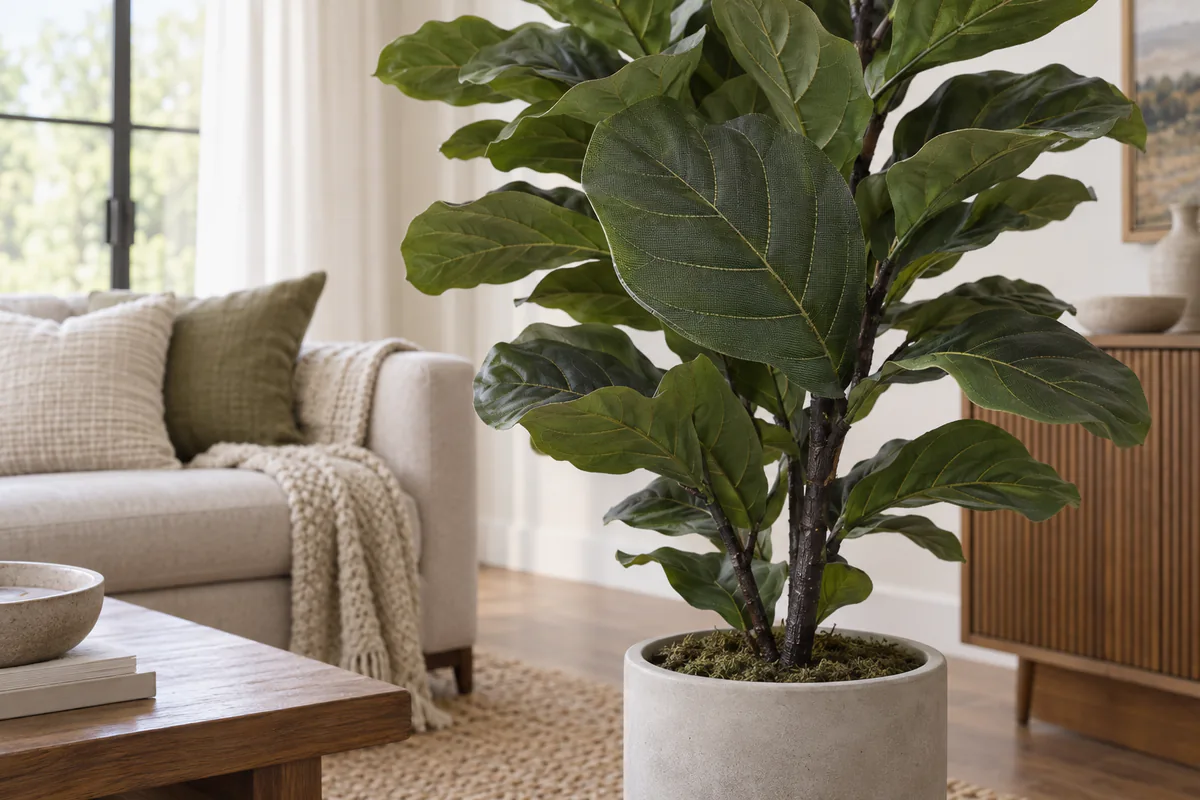
Select artificial plants for the room and viewing distance
This guide does not rank current product models. Before buying, compare dimensions, material, foliage density, pot stability, cleaning instructions and return terms for the exact item. Inspect product photos at the scale and viewing distance where it will be placed.
Check the manufacturer’s material description and avoid relying on broad claims such as “realistic,” “non-toxic” or “pet-safe” without documentation for the model.
Choose placement by light, moisture and access
Room conditions affect dust, humidity and fading. Keep artificial plants clear of heat sources, exits and areas where they could be knocked over. In kitchens and bathrooms, check the maker’s cleaning and moisture guidance; not every material suits humid or greasy conditions.
Use a stable base in homes with pets or children, and secure tall items against tipping.
Compare material and construction documentation
“PE,” “silk” and “plastic” can describe different materials and finishes. Check the exact product label for foliage, wire, stems, pot material and cleaning limits. Photos and category names are not enough to assess durability, odor, fire performance or chemical safety.
As one model-specific example, Nearly Natural lists its 7 ft. artificial Kentia Palm as plastic and polyester, with a 7 ft. height including an 8 × 8.5 in. pot, a 4.5 ft. width and a 4 ft. depth. Those dimensions help check room fit; they are this listing’s details, not a category standard or independent quality assessment. Confirm the live product specification before relying on it.
Use the manufacturer’s written care and material information and avoid unsupported safety claims.
Choose a form that suits the room
Artificial versions of familiar plant shapes vary widely. Choose by height, leaf shape, color, density and stability rather than assuming one species name guarantees a convincing appearance. Read exact dimensions and compare them with the placement; a pot shown in a photograph may not be included.
Style with scale, container and placement
Choose a container that supports the plant’s height and weight, and check whether it is included. Adjust stems only as the maker permits. Keep the item away from direct heat and routes where it may snag or tip. A few well-placed pieces may be easier to dust and maintain than densely arranged foliage.
Clean according to the material and maker’s instructions
Dust accumulation can make foliage look dull. Nearly Natural’s care guide describes dusting as a maintenance option for its artificial plants, but care methods vary by material and product. Use only the method allowed by the maker for the exact item—such as a soft cloth or duster—and test an inconspicuous area first. Avoid water, detergents, solvents or compressed air unless the product documentation permits them. The appropriate cleaning interval depends on dust and placement, not a fixed weekly rule.
Check realism at the distance where it will be seen
Photographs often show artificial plants close up under carefully arranged lighting. Evaluate the leaves, stems, pot and visible joins from the position where the item will normally be viewed. Repeated leaf shapes, glossy plastic, exposed wire or a sparse back can be more obvious at a window or beside a mirror. Ask for unedited photographs of the exact model if the listing does not show the whole plant from several angles.
Consider whether the plant must be viewed from all sides. A wall-mounted arrangement may only need a finished front, while a freestanding tree should look complete around its trunk and base. Check the stated height including the pot, width at its widest point and whether branches can be reshaped safely. Compare the container with your room furniture; a small plant in an oversized pot or a tall tree squeezed beside a doorway can look out of scale.
Use a practical indoor buying checklist
- Measure the floor, shelf or tabletop and allow access for cleaning, doors and foot traffic.
- Check the exact dimensions and whether the stated height includes the planter or display base.
- Read the materials for leaves, stems, frame, pot and any weighted fill; do not assume all parts are plastic or reusable.
- Look for stability information, especially for tall trees in homes with children, pets or active walkways.
- Ask how to clean and store the item, and whether any warranty covers fading or broken branches.
- Keep the product away from flames, heaters and hot bulbs unless the maker documents that placement as suitable.
Do not treat “non-toxic,” “eco-friendly” or “recyclable” as meaningful across an entire product based on one material. Check which component the claim covers and whether the maker provides evidence. The FTC’s Green Guides summary explains why broad environmental claims need substantiation. For a long-lasting display, choose a piece you can maintain and store, and compare construction details instead of relying on styled photos alone.
Place artificial plants safely around people and pets
Even a decorative plant can create a hazard if it is tall, top-heavy or positioned where it can be pulled over. Check the base and any internal support, and place heavy pieces on a stable floor rather than an unstable shelf. If a model comes with small removable berries, leaves or ornaments, check that they cannot be accessed by children or pets who might put them in their mouths.
Artificial foliage should not be described as pet-safe merely because it is not a live plant. Materials can include wire, coatings, adhesive, fabric or small plastic components. Keep pieces out of reach of pets that chew décor and ask a veterinarian if an animal has swallowed material. Secure tall trees against tipping only with a manufacturer-approved method.
Keep artificial plants away from candles, heaters and hot bulbs unless the maker confirms that the materials are suitable for that location. Do not block access to windows, doors, ventilation, smoke detectors or electrical panels with a large display. For offices, hotels or public spaces, follow the facility’s requirements for fire safety and cleaning.
Inspect the arrangement after moving it or changing the container. Loose branches, exposed wire or a damaged base can make the item harder to handle and clean. A product with unclear material or care information may be a poor choice for a room where children, pets or frequent visitors can touch it.
Frequently asked questions
Judge indoor faux plants at the distance and light where they will sit. Check leaf shape and finish, visible seams, stem flexibility, pot stability, dust access and the exact materials listed by the seller; room humidity alone does not establish that an item is suitable for wet locations. This page offers selection criteria rather than a verified product ranking. For pet safety, confirm the exact material and small detachable parts with the manufacturer instead of assuming every artificial plant is harmless.
Plan cleaning and replacement for an indoor display
Before buying, consider how the display will look after dust, movement and routine cleaning. Fine or densely packed foliage takes longer to clean than a simple silhouette, and a detailed arrangement may be hard to reach once placed on a high shelf. Check the maker’s care instructions for the exact material; avoid soaking, solvents or heat unless the manufacturer specifically permits them. Test a gentle method on a hidden area first when instructions are limited.
For a multi-piece arrangement, record what can be replaced separately: stem, leaf, pot, weighted base or insert. Modular pieces may be easier to maintain than a permanently glued arrangement, but this depends on the construction. Keep receipts and model information with the care notes, especially if the maker offers a stated warranty. Treat warranty coverage, fire performance and material composition as product-specific claims and ask for written documentation where those details matter.
Consider where the item may be handled. In a child’s room, pet area or narrow hallway, avoid loose parts, exposed wire ends and unstable bases. Keep the display away from cooking flames and hot lamps unless its documentation states that the materials are suitable for that environment. A realistic photograph can hide these practical details, so ask for close-up views and exact dimensions before deciding.
Environmental language should also be specific. “Recyclable” can depend on the material combination and local collection facilities, while a general “green” claim may not explain the product’s actual impact. Ask which components are covered and whether a take-back or repair route exists. The U.S. FTC’s Green Guides summary explains why broad environmental claims need clear support. It does not assess a particular artificial plant; verify claims with the seller or manufacturer for the exact item.
For a broader context, continue with the artificial plants guide and outdoor artificial plants.