

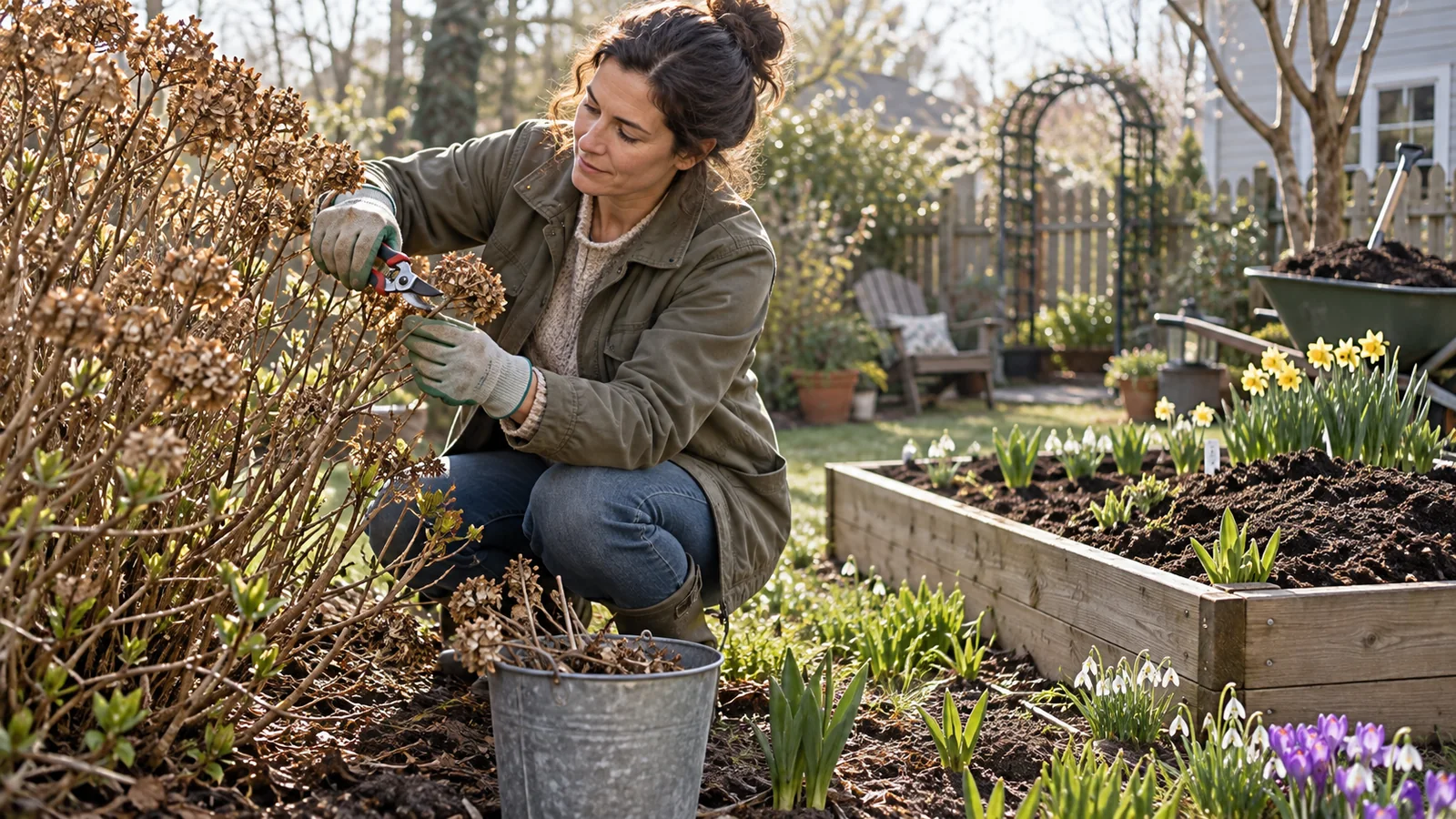
When to start your spring garden prep
The standard trigger for spring garden work is your last frost date, which varies significantly across the US. You can find your exact date on the Old Farmer's Almanac website or through your local county extension service. As a rough guide: Zone 3–4 (northern Minnesota, upper Great Plains): last frost mid-May to early June. Zone 5–6 (Midwest, New England, mid-Atlantic highlands): last frost April to early May. Zone 7–8 (Southeast, Pacific Coast, lower Midwest): last frost March to mid-April. Zone 9–11 (Deep South, Southern California, Hawaii): frost-free or last frost January–February.
The practical approach: start cleanup and pruning tasks as soon as temperatures are consistently above freezing and you can work the soil without compacting it (soil crumbles when you squeeze a handful rather than forming a sticky ball). Start fertilizing and mulching after the last frost has passed. If frost threatens after you have started, protect tender new growth with row cover or frost cloth overnight.
1. Assess and clear winter damage
Walk through your entire garden before starting any active work and take notes on what needs attention. Look for: broken branches (cut back to a clean node or the trunk collar), frost-killed stems on perennials and shrubs (brown, papery, or mushy tissue that does not spring back), heaved plants where frost has pushed root balls out of the soil (press them back down firmly), and any areas where mulch has been blown away, leaving exposed soil and roots.
Clear the debris first — dead leaves, fallen twigs, and old plant stems left from last year. This material harbors overwintering fungal spores and insect pests that will reinfect your plants the moment temperatures warm. Bag diseased material for trash; healthy plant debris can go to the compost pile. Once the beds are clear, you can accurately assess what survived winter and what needs replacing.
Check any bulbs you planted last fall: tulips, daffodils, and hyacinths should be showing green shoots by the time soil temperatures exceed 40°F. Dahlias and cannas in cold zones (5 and below) that were stored indoors should be checked for rot before replanting. Discard any that are soft, mushy, or moldy.
2. Prune shrubs, roses and perennials
What to prune in spring (and what to wait on)
Spring is the right time to prune: roses (cut hybrid teas and floribundas back by one-third to one-half once buds are swelling); late-blooming shrubs such as hydrangeas that bloom on new wood (panicle hydrangeas, smooth hydrangeas — cut hard, to 6–12 inches); ornamental grasses (cut to 4–6 inches before new growth emerges); perennials (remove last year's stalks down to the emerging crown); and evergreen hedges (light shaping to remove winter dieback).
Do NOT prune in spring: spring-blooming shrubs such as forsythia, lilac, and viburnum that bloom on old wood — prune immediately after flowering in May or June; oakleaf hydrangeas and bigleaf hydrangeas — prune only after bloom or not at all unless removing dead wood; and any flowering trees in bud (cherry, crabapple, redbud) — wait until after bloom.
Fiskars Steel Bypass Pruning Shears — 5/8' Cut Capacity
- ✓ Hardened steel blade stays sharp through heavy use
- ✓ 5/8-inch cutting capacity for stems, canes and small branches
- ✓ Low-friction coating reduces gumming and sticking on sappy cuts
- ✓ Softgrip handle with ergonomic comfort for extended use
- ✓ Fully hardened precision-ground steel for long edge retention
- ✓ Lifetime warranty from Fiskars
No verified direct Amazon.com listing is linked for this exact model.
Use clean, sharp tools for all pruning. Dull blades crush stems and leave ragged cuts that heal slowly and allow disease entry. Wipe blades with rubbing alcohol between cuts when working on plants with suspected disease. For branches larger than 3/4 inch in diameter, switch from hand pruners to loppers or a pruning saw for cleaner cuts.
3. Improve your soil before planting
Soil is the foundation of everything in the garden, and spring is the best time to improve it before the growing season begins. The two most impactful soil amendments are: compost (spread 2–3 inches across all garden beds and work into the top 6 inches — improves drainage in clay, adds structure to sandy soil, adds micronutrients to all types); and balanced fertilizer applied at the start of the growing season when roots are just becoming active.
For vegetable gardens and annual flower beds, a full soil turnover (digging 8–12 inches and incorporating compost) gives you the best possible growing medium. For established perennial beds, a gentler top-dress of compost worked in with a garden fork is sufficient — deep digging disturbs perennial root systems and can damage shallow-rooted plants. Always work soil when it is moist but not wet. Walking on or digging wet soil causes compaction that can take years to fully reverse.
4. Spring lawn care: the key tasks in order
The lawn benefits from a specific spring care sequence: clean up first, then assess damage, then dethatch if needed, then fertilize, then overseed bare spots. Do not apply pre-emergent herbicide if you plan to reseed — pre-emergent blocks all seed germination, including grass seed. If weed pressure is high, choose between overseeding now and applying pre-emergent, or waiting until fall for overseeding and applying pre-emergent this spring.
First mow: when grass is actively growing and reaches 3.5–4 inches tall. Keep height high (3–3.5 inches) for the first several cuts of the season — tall grass develops deeper roots and outcompetes weeds. Lower height gradually through May. Spring fertilizer: apply a slow-release granular fertilizer after the first mow when the lawn is growing strongly but temperatures are still below 80°F. Overseeding: fill thin and bare patches with appropriate grass seed after aerating.
Scotts Turf Builder Lawn Food — Spring & Summer Fertilizer
- ✓ Feeds and strengthens lawn to protect against heat and drought
- ✓ WaterSmart technology feeds lawn for up to 8 weeks
- ✓ Suitable for all grass types including cool-season and warm-season
- ✓ Apply with Scotts spreader for even distribution
- ✓ Safe for the whole family and pets when used as directed
- ✓ Covers up to 5,000 sq ft per bag
No verified direct Amazon.com listing is linked for this exact model.
5. Inspect and restart your irrigation system
Before the weather heats up, inspect every component of your irrigation system. Winter freezes cause cracks in PVC pipe joints, split drip tubing, and damage sprinkler heads. Turn on each zone individually and walk the perimeter while it runs — look for sprinkler heads spraying in the wrong direction, drip emitters clogged with mineral deposits, and wet spots in areas that suggest underground leaks.
Clean or replace clogged drip emitters (a common spring maintenance task in hard-water areas). Replace any cracked tubing. Adjust sprinkler heads that have been knocked out of alignment over winter. Update your controller's schedule: spring watering should be shorter and less frequent than summer settings. A good spring starting point is 15–20 minutes per zone, 2–3 times per week, adjusted based on rainfall. Install a rain sensor if you do not already have one — they save hundreds of gallons per season by skipping programmed cycles after natural rainfall.
6. Hedges and shrubs: first cut timing
For evergreen hedges (boxwood, arborvitae, privet, yew), the first shaping cut of spring should happen after the initial flush of new growth hardens off — typically late April to mid-May in most US zones. Cutting too early, before the new growth has pushed, means you will cut off the fresh tips that create a dense outer surface. Cutting too late means you are trimming back long, straggly growth instead of compact new tips. Watch for the bright green new growth to firm up and lose its soft, floppy character before you trim.
For mixed shrub borders with a combination of flowering and non-flowering shrubs, prune each plant according to its type (spring-bloomers after bloom, summer-bloomers now in spring) rather than treating the border as a single unit. The 10 minutes spent identifying what you have before cutting will save you from accidentally removing an entire season of flowers.
Spring garden checklist by month
| Month | Key Tasks | US Zones |
|---|---|---|
| February | Clear debris, check bulbs, prune roses, start seeds indoors | Zone 8–11 |
| March | Prune shrubs, start lawn care, aerate and overseed (mild zones) | Zone 7–9 |
| April | Fertilize lawn and beds, aerate and overseed, plant cool-season crops | Zone 5–7 |
| May | After-frost planting, summer mulching, first hedge trim, restart full irrigation | Zone 3–5 |
Tool maintenance: sharpen and clean before the season
Dull, rusty tools make every garden task harder and produce worse results. Dedicate one session at the start of spring to cleaning and sharpening your core tools. Wipe metal surfaces with an oily rag to prevent rust. Sharpen pruner and lopper blades with a diamond whetstone or take them to a local sharpening service. Clean any soil and debris from trowels and spades; sharpen their working edges with a file. Inspect wooden handles for cracks or looseness in the handle ferrule — replace rather than risk a tool breaking mid-use.
Pine Tree Tools Bamboo Working Gloves — Women and Men
- ✓ Bamboo fiber breathable liner for comfort during long sessions
- ✓ Nitrile micro-foam coating for grip and light waterproofing
- ✓ Fits snugly for precise feel when pruning or planting
- ✓ Machine washable — maintain hygiene all season
- ✓ Available in multiple sizes, men and women
- ✓ Outstanding grip on both dry and wet surfaces
No verified direct Amazon.com listing is linked for this exact model.
Store fertilizers, pesticides, and soil amendments in a cool, dry location — not in direct sunlight where active ingredients degrade. Check the expiration dates on any products left from last year; most granular fertilizers remain effective for 3–5 years if kept dry, but liquid fertilizers and pesticide concentrates may degrade faster. When in doubt, take old pesticide products to a local household hazardous waste collection event rather than dumping them.