

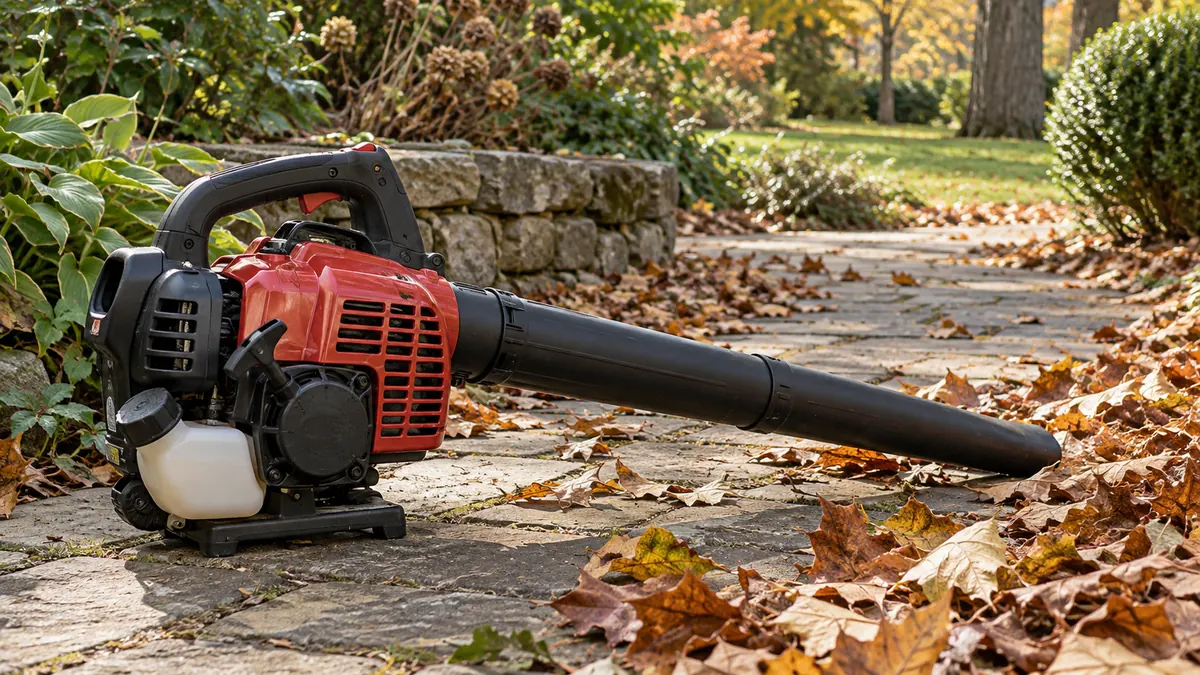
Makita BHX2501 manufacturer specifications
| Specification | Makita France listing | What to verify |
|---|---|---|
| Engine | Four-stroke, 24.5 cc | Unit nameplate and applicable manual |
| Output | 0.81 kW; maximum output listed as 1.1 hp | Manufacturer terminology and conditions |
| Air volume | 606 m³/h or 10.1 m³/min | Published figure, not measured garden productivity |
| Air speed | 64.6 m/s | Configuration stated by manufacturer |
| Fuel tank | 0.52 L | Makita does not state runtime in the cited listing |
| Engine oil | 10W-30 | Exact manual, level and service interval |
| Net weight | 4.5 kg | Compare the complete tool with attachments installed |
| Noise and vibration | 90.8 dB(A) LpA; 103.7 dB(A) LwA; 9.3 m/s² | These are different measures; check test method and PPE instructions |
These are manufacturer-published values, not measurements from our own test. We do not convert them into an estimated runtime, area per hour or productivity comparison. Work results also depend on leaf type and moisture, nozzle, throttle position, technique, access and the operator's noise tolerance.
Four-stroke engine and fuel procedure
Makita identifies the BHX2501 as a four-stroke engine that does not use a two-stroke petrol-oil premix. Engine oil is handled separately; the specification page lists 10W-30. That removes one fuel-mixing step but does not eliminate oil checks, routine maintenance or the need to follow the manual for the exact unit.
Before refuelling or servicing, let the engine cool and work away from flames. Do not apply instructions from a two-stroke trimmer or blower. Fuel grade, oil, starting procedure and storage may depend on model revision and market. If the unit is imported or old, ask an authorized service shop about suitable consumables and parts before operating it.
Understand what the four-stroke design changes
The documented difference is the fuel and oil arrangement: this engine uses gasoline in its fuel tank and engine oil in a separate sump, rather than the 50:1 premix used by many two-stroke blowers. The operator must still confirm the correct fuel grade, oil type, level-check method and service interval in the BHX2501 manual. Do not pour two-stroke mix into this machine or assume any automotive oil meets the maker's requirement.
Four-stroke construction also means there are engine-service items beyond clearing the air tube. The cited specification gives 0.52 L tank capacity and a 4.5 kg net weight, but does not publish a runtime claim. Actual fuel use depends on throttle, workload and condition, so a tank-size calculation cannot establish how many minutes or square metres it will clear. Treat fuel consumption, sound and vibration as part of the ownership decision, not only airflow.
Before using a blower that has sat for a long period, inspect it for stale fuel, cracked fuel lines, a stuck throttle, clogged filter, loose exhaust fasteners and corrosion. Use the manual's start-up procedure. If it leaks fuel, stalls under light load or has damaged safety controls, do not continue running it; have it inspected by a qualified service provider. A four-stroke engine is not maintenance-free just because it avoids premixing.
Air speed, volume and practical limits
Air speed and air volume describe related but different aspects of airflow. Speed is stated in metres per second, while volume is stated in cubic metres per hour or minute. Compare the same units and test conditions; the highest speed alone does not decide which blower moves a particular pile of leaves. Makita lists 64.6 m/s and 606 m³/h, also stated as 10.1 m³/min.
For dry leaves on a path, work from the edge toward a collection area and, when practical, with the wind behind you. On gravel, mulch or delicate beds, reduce throttle and keep more distance so you do not move soil or cover. Wet or compacted debris may need a rake or vacuum. A published airflow figure does not guarantee that every surface or leaf type will clear equally well.
The 4.5 kg catalogue weight does not describe effort over a full session. Add fuel and the fitted accessory, then consider grip, balance, posture and vibration. Stop if mass or vibration makes the blower difficult to control.
Blower tube and optional vacuum kit
Makita lists the blower tube as standard equipment and the vacuum kit as a separate optional accessory, part number 195283-6. A listing for the blower does not mean that it includes the vacuum bag, tubes or any shredding parts. Verify the box contents and fit against the manufacturer's accessory record for the actual model.
Before attaching the kit, check the fasteners, orientation and operating steps in the manual. Remove stones, wire and branches from the intake area. Do not feed materials that the manufacturer does not permit or open the housing while the engine is running. If a seller shows an accessory without a model number or clear package list, do not assume that it is included.
Offer, parts and market checks
The ASIN previously associated with the BHX2501 identified the model, but its Amazon.com page did not show an active deliverable offer during the latest review. The page therefore removes purchase links and static prices. A past listing is not proof that a product is currently available.
For a used unit, check the BHX2501 code, engine condition, filter, blower tube, tank, throttle cable and starter parts. Confirm local service and parts availability. A genuine tool can still be an imported version with different documentation, warranty or support in the buyer's region.
Inspect a used or stored BHX2501
- Match the machine's nameplate to BHX2501 and check whether the listing includes the blower tube, nozzle and optional vacuum parts.
- Look for fuel seepage, a damaged tank, a cracked primer bulb or fuel lines, and a loose or bent shaft connection.
- With the engine off and cool, inspect the air filter, spark plug lead, starter rope, intake screen and throttle return.
- Ask for service history and the correct regional manual; do not start an unknown engine with stale fuel or an uncertain oil level.
- Confirm parts are obtainable in the buyer's market before paying for an older machine.
A seller demonstration should take place outdoors on stable ground with the correct safety gear. Observe whether the machine starts and idles normally, whether the tube stays secure and whether there is unusual vibration or smoke. This is a basic inspection, not a substitute for a mechanic's assessment or a compression test.
Use and maintenance safety
Use the gasoline blower outdoors; never run its engine in a garage, greenhouse or other enclosed space. Wear eye and hearing protection, stable footwear and the clothing specified by Makita. Keep others outside the path of debris and do not aim airflow or stones at pedestrians, animals, windows or vehicles. Observe local noise rules.
Before use, check that the tube is secure, the intake is clear and there are no fuel leaks. To clean, adjust, install the optional kit or transport the tool, switch off the engine and allow it to cool. Follow Makita's maintenance schedule for oil, filter, spark plug and storage. Stop operation if the blower vibrates unusually, is damaged or will not start normally, and consult a qualified service shop.
When inspecting a used or stored BHX2501, check the model plate and applicable manual before starting. Look for fuel leaks, cracks in the housing or tube, loose fasteners, damaged rubber mounts and a dirty or deteriorated filter. Do not start a unit that smells strongly of gasoline or has an uncertain oil level. Makita’s cited four-stroke version uses separate engine oil; the manual, not a generic small-engine rule, controls quantity and service interval.
The blower’s 0.52-litre tank does not establish runtime. Makita does not publish a comparable working-time figure in the cited product specification, and load varies with debris and throttle. Do not convert tank size into an hours-of-use claim. If the motor stalls, vibrates unusually or loses power, stop and seek service instead of adjusting the carburetor or exhaust by guesswork.
The optional vacuum kit is part 195283-6 in the cited regional source; it is not included automatically with every BHX2501 package. Confirm the part number, tube connection, bag and local availability with Makita service. The model page documents a French-market specification and does not verify a current US Amazon offer, warranty or exact package for another country.
Four-stroke fuel handling is a real ownership difference: gasoline and crankcase oil are kept separate, and the oil level must be checked as specified before use. Never fill the oil through the fuel tank or use a two-stroke premix by default. If the blower has been stored for a long period, use the manual’s preparation steps, inspect for leaks and confirm that the correct oil is present. A cold start should follow the maker’s sequence rather than repeated throttle adjustments.
Makita’s figures are from a French-market source. A buyer in another country should confirm emissions compliance, service support, parts and the exact package by model code. The Amazon.com offer was not verified for the cited BHX2501, so this page does not preserve an affiliate purchase box. The model remains a documentary reference with its specifications and optional vacuum-kit status clearly separated from availability.