

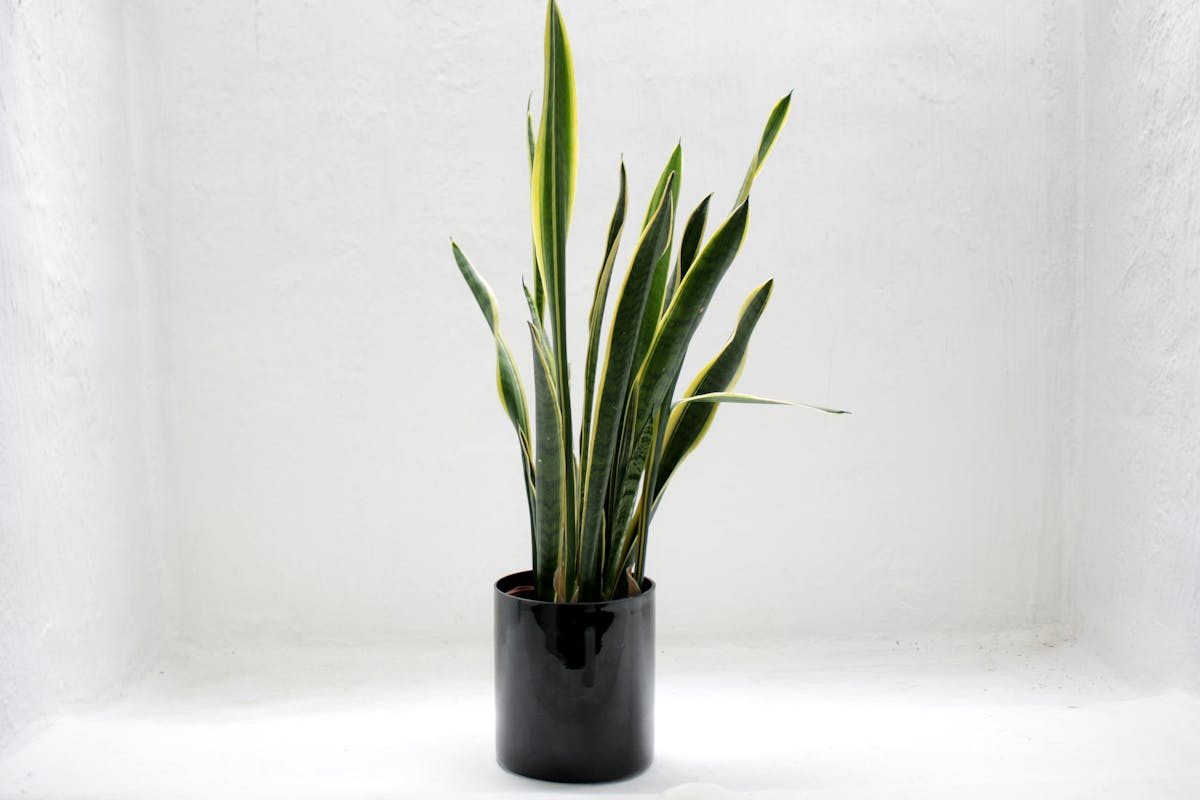
Light and placement
Bright indirect light usually supports stronger growth, while snake plants can tolerate lower-light rooms. Avoid harsh direct sun if it scorches foliage. Keep the pot away from cold drafts and place tall varieties in a stable, heavy container so leaves do not tip it over. Penn State Extension’s snake plant guide describes the plant’s light and soil needs.
Watering and soil
Use a succulent or cactus mix, or another porous medium, in a pot with drainage. Water thoroughly and let excess drain; wait until the mix is dry before watering again. Winter light and growth slow, so the mix may remain wet longer. Do not apply fixed weekly schedules without checking the pot.
Divide or root leaf cuttings
Division is the simplest way to preserve a named cultivar: separate a rhizome section with roots and a growing point. Leaf cuttings can root, but variegated cultivars may not retain their leaf pattern when grown this way. Use clean tools and give fresh cuttings time to establish before watering heavily.
Common problems and safety
Soft leaves at the base often indicate excess moisture or root problems; check the mix and roots. Wrinkling may reflect prolonged dryness, but also inspect for damaged roots. Snake plants can be toxic to pets if ingested, so place them out of reach and verify the exact species with a veterinary source. See the University of Minnesota indoor-light guide for related plant comparisons.
Choose a snake plant form and stable pot
Snake plant is used for several upright and rosette-forming houseplants now classified in Dracaena. The botanical label helps you compare leaf height, growth habit, and variegation. A tall sword-leaved type needs a stable base and room for vertical growth, while a compact rosette fits a smaller shelf. Do not assume all plants sold as “sansevieria” share the same mature size or propagation behavior.
Pick a pot with open drainage holes and enough weight to support the leaves. A heavy outer pot can improve stability only if the inner pot drains and runoff is emptied. Avoid placing a decorative pebble layer over the soil; it does not fix blocked drainage and can make moisture harder to judge. Keep the crown and leaf bases above the mix.
A porous succulent mix is useful because the rhizomes and roots are vulnerable to prolonged wetness. If using a commercial houseplant mix, check that it drains freely and does not compact into a dense mass. When the plant is top-heavy, choose a container that balances its height rather than moving up several pot sizes. A large amount of unused wet soil can create the conditions for rot.
Place the plant in bright indirect light for steady growth, with lower light tolerated by many types. If a room is dim, expect slower growth and less reliable new leaves. Rotate the pot occasionally for even exposure. Strong direct sun through hot glass may scorch foliage, so acclimate the plant gradually if moving it closer to a bright window.
Adjust watering to light and season
Check the entire mix before watering; a dry surface can cover damp soil near the bottom. When the mix is dry, water thoroughly and allow the pot to drain. Do not leave water in a cachepot or saucer. The interval changes with pot size, room temperature, light, and season, so a fixed weekly schedule is especially risky for this drought-tolerant plant.
In winter or in a low-light room, growth may slow and the soil can take longer to dry. Wait until the mix is dry rather than watering because a certain number of days has passed. If leaves wrinkle, inspect the root system and soil before watering; damaged roots cannot absorb water normally. If the plant is outdoors in a warm season, protect it from cold and rain that keeps the pot saturated.
When watering, apply water evenly across the mix rather than pouring it into the center of the leaf rosette. Let excess drain completely. If water rushes down one side of a very dry root ball, apply it in a second pass after the first has soaked in. Empty saucers and cachepots after watering. Keep foliage dry when possible, particularly in cool rooms where wet leaves take longer to dry.
Fertilize sparingly during active growth with a product labeled for houseplants or succulents. Do not use fertilizer to treat slow growth in a dark room or rotting roots. A plant that has been in the same container for years may need fresh mix, but repot only when the roots or medium indicate a reason. Follow the product label and avoid feeding a newly divided or stressed plant.
Propagate by rhizome division step by step
Division is the most straightforward way to preserve a variegated cultivar’s leaf pattern. Remove the plant from its pot when the mix is dry enough to release, then brush soil away until you can see the rhizomes. Use a clean sharp knife to separate a section that has roots and a growing point. A leaf without rhizome tissue will not create a full division.
Let damaged cut surfaces dry before potting if the plant’s condition and room conditions allow. Set each division into a small draining pot with a porous mix, keeping the base at the same depth it grew previously. Do not choose a large pot for a small division. Label the cultivar and date, especially if you are separating several types.
Keep the new division in bright indirect light and avoid heavy watering until it is established. A leaf may remain unchanged for a while as roots settle; do not unpot it repeatedly to check. Resume watering based on soil dryness, not a propagation calendar. If the division has no roots or growing point, it may not establish and should not be treated as equivalent to a viable rhizome section.
Leaf cuttings are another option, but they can produce plants with different variegation from the parent. Cut a healthy leaf into sections, keep the orientation consistent, and place them in a suitable propagation medium. Label the cultivar and understand that rooting and new growth can take time. For a plant whose exact leaf pattern matters, use division instead of leaf cuttings.
Diagnose soft leaves, wrinkles, and slow growth
| Symptom | Check before changing care | Response |
|---|---|---|
| Soft or dark base | Is the mix wet, the pot blocked, or the rhizome soft? | Stop watering and inspect the roots; remove decayed tissue with clean tools. |
| Wrinkled leaves | Has the mix been dry for a long time, or are roots damaged? | Water only if roots are sound and the mix is fully dry. |
| Leaning or falling leaves | Is the pot stable, is growth one-sided, or is the base weakened? | Improve support and light; check for rot before staking damaged leaves. |
| Scorched patches | Was the plant moved into direct sun or beside hot glass? | Return it to filtered light and acclimate gradually. |
| No new leaves | Season, light level, pot crowding, and root health | Correct the site and wait; slow growth alone is not a reason to feed heavily. |
Cut away a damaged leaf only if it is dead or collapsing, using clean tools. Removing healthy leaves to improve appearance reduces the plant’s foliage and does not fix a root problem. If symptoms spread, photograph the base and roots and consult a local extension service. Penn State Extension’s snake plant guide provides additional growing context.
Repot and maintain the plant safely
Repot when rhizomes crowd the pot, roots emerge densely from the drainage holes, or the medium has compacted and no longer dries predictably. Use a pot only modestly larger and fresh free-draining mix. A snug pot is often workable; frequent repotting can damage roots and set the plant back. Water according to the new medium after repotting, not the former pot’s schedule.
Wipe leaves with a damp cloth to remove dust and check for pests. Support the leaf while cleaning to avoid cracking it. Inspect the soil line and undersides for scale or mealybugs. Isolate an affected plant, identify the pest, and choose a product labeled for indoor ornamental plants if needed. Keep pesticides and plant material away from children and pets.
Snake plants can be harmful if eaten. The ASPCA lists its snake-plant entry as toxic to dogs and cats. Keep plants inaccessible to pets and children, especially when a pot is placed on the floor. If an animal chews a leaf, contact a veterinarian or an appropriate poison-control service with the plant identity. Do not rely on a common name alone if the species is uncertain.
Respond to suspected root rot carefully
If leaves become soft at the base or the pot smells sour, remove the inner pot from any cachepot and check the mix. If it is wet, do not water again. Take the plant out only when there is a reason to inspect the roots, and brush away enough soil to see whether rhizomes and roots are firm or decayed. A healthy plant with one older leaf does not need a full repot just because a leaf is unattractive.
Use clean tools to remove clearly rotten roots or rhizome sections. Keep firm tissue and discard soft material; do not try to save decayed parts by planting them in fresh soil. If the plant is divided, each section needs a sound growing point and rhizome. Allow cuts to dry before repotting when practical, then use a small draining pot and porous mix sized to the remaining roots.
After repotting, keep the plant in bright indirect light and let the mix dry between waterings. Do not fertilize until new growth confirms that the plant has resumed active growth. If the remaining rhizome is very small, avoid watering heavily because it cannot use a large volume of moisture. Check progress from the leaves and firmness instead of repeatedly unpotting it.
If root rot returns, review the conditions that caused it: pot without holes, heavy soil, oversized container, cool low-light room, or frequent watering. Change the cause before replacing the plant. A commercial succulent mix may help only if it drains through a suitable pot; no mix can compensate for a blocked cachepot or standing saucer water.
For future prevention, note how long the pot takes to dry after a thorough watering. Compare that time across seasons and locations. A plant beside a warm bright window will use water differently from one in a cool office. Penn State Extension’s snake plant guide is a source for the plant’s general care, while your own drying observations help adapt the routine to the room.
Inspect and acclimate a new snake plant
Before buying or repotting, check the botanical name, leaf firmness, and condition of the soil. A soft or dark base can signal root or rhizome trouble, while a few small surface marks may be cosmetic. Inspect leaf joints and the soil for insects. Keep a new plant separate from a houseplant collection until you are confident that it is pest-free.
Remove any decorative sleeve that traps water, but do not rush to repot a healthy plant immediately. Let it adjust to a stable bright indirect location. If the nursery kept it in lower light, increase exposure gradually and watch for scorch. Avoid placing it directly beside cold glass, a heater, or a door that creates a draft.
Save the cultivar label and photograph it before discarding. It can clarify mature size and leaf pattern, and it helps you find care information under the plant’s current botanical name. Common names such as “snake plant,” “mother-in-law’s tongue,” and “sansevieria” may refer to different forms. Check the plant identity before repeating a toxicity or care claim from an online source.
Before placing it in a collection, clean the display pot and check that excess water can drain freely.