

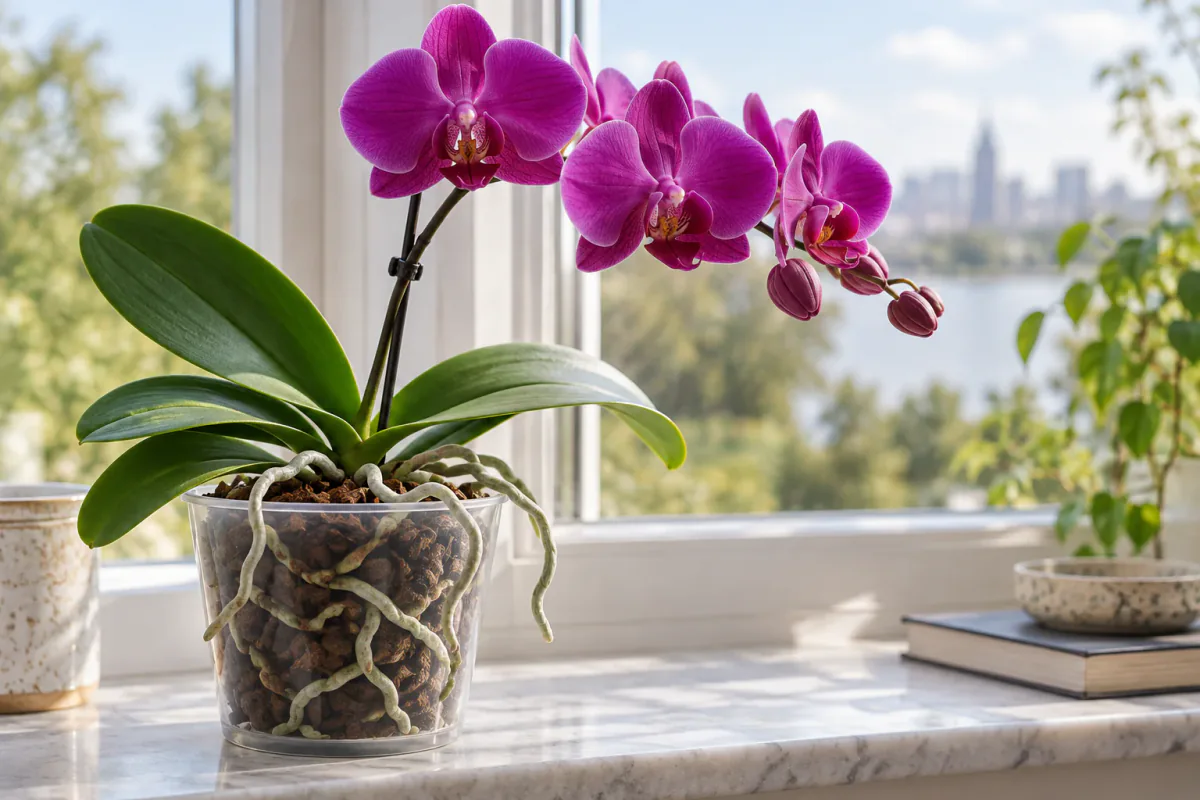
Start with the orchid’s name
This page focuses on Phalaenopsis, the common grocery-store orchid. Dendrobium and Cymbidium differ in temperature, rest, and flowering cues; do not apply Phalaenopsis instructions to them. The American Orchid Society publishes culture sheets by genus, which are the better source when the plant label names another orchid.
Give bright, filtered light
An east-facing window or a shaded brighter window is a useful starting point. Watch leaves for signs of too much or too little light, and move the plant gradually. Avoid strong afternoon sun that heats the leaves. The American Orchid Society’s Phalaenopsis sheet explains how exposure varies with climate and window orientation.
Water without keeping roots soggy
Water the medium thoroughly and let it drain. Wait until it is nearly dry before watering again; the interval changes with temperature, season, pot, and medium. Keep water out of the crown and allow foliage to dry. If the bark has broken down or roots have turned soft, repot in fresh porous orchid medium and remove dead roots with clean tools.
Set realistic rebloom expectations
After flowers fade, inspect the spike. A green spike may sometimes produce another branch, while a brown or dry spike can be removed near the base. Rebloom depends on light, temperature, plant condition, and cultivar; it is not guaranteed on a fixed schedule. See the American Orchid Society Phalaenopsis culture sheet for detailed care and its rebloom troubleshooting guide.
Check the orchid genus before following care advice
“Orchid care” is not one recipe. This guide focuses on Phalaenopsis because moth orchids are common houseplants, but other genera may need different seasonal temperatures, watering patterns, or rest periods. Check the plant tag, original pot label, or seller’s listing for the genus and hybrid name. If the tag is missing, compare flower and growth features with an authoritative orchid source before changing care.
| Label you may see | What to do before applying this guide | Why it matters |
|---|---|---|
| Phalaenopsis or moth orchid | Use the steps on this page and the matching culture sheet | Care details here are written for this group. |
| Dendrobium | Find the Dendrobium culture sheet for the type and hybrid | Temperature and rest cues can differ from moth orchids. |
| Cymbidium | Check the Cymbidium sheet and regional temperature guidance | Its seasonal flowering conditions are not the same as Phalaenopsis. |
| Unknown or mixed label | Ask the seller or an orchid society to identify it | Watering by leaf appearance alone can harm the wrong genus. |
The American Orchid Society publishes care sheets by genus, which is a better starting point than a generic social-media schedule. Keep the label with the pot or take a photo so you can find the same information later. A plant with similar-looking leaves may still belong to a different group. This page intentionally avoids prescribing a universal temperature or rest period for all orchids.
Read the roots and choose an airy medium
Phalaenopsis roots are adapted to an airy growing environment. In a clear pot, healthy roots may appear firm and green when wet or silvery when dry; appearance varies with light and root age, so texture and smell are also useful. Soft brown roots, a sour odor, or bark that stays wet for a long time are stronger reasons to inspect the root system than a single color change.
Use a porous orchid medium such as bark in a pot with drainage. Dense standard potting soil can hold too much water around roots that need air. A clear inner pot makes root observation easier, but it is not essential if the container drains and the grower can check the medium. Decorative cachepots should be emptied after watering rather than holding runoff.
Repot when the medium has broken down, roots are decaying, or the plant no longer sits securely. Choose a pot that fits the remaining healthy roots rather than moving a small plant into a much larger container. Remove dead or hollow roots with clean scissors, preserve firm roots, and set the base of the leaves above the medium. Do not bury the crown, where water can collect.
Fresh bark may dry at a different rate from old medium. After repotting, check moisture more often but do not water on a fixed daily schedule. Avoid repeatedly pulling the plant out to inspect it; give roots time to settle. If a bloom spike is present, wait until the plant is stable unless a serious root problem makes repotting necessary.
Use a safe watering workflow for Phalaenopsis
Check the pot and medium before watering. If bark is still damp and roots feel firm, wait. If the medium is nearly dry and the pot feels light, water thoroughly so the roots and bark are moistened, then let every drop drain. Do not leave the pot standing in water, and avoid pouring water into the leaf crown. Watering frequency changes with room temperature, pot size, airflow, season, and the type of medium.
Room-temperature water is a practical choice. If using tap water leads to mineral deposits on the medium or pot, review your local water quality and the orchid society’s guidance for your plant. Avoid softened water when it contains added salts. Do not use ice cubes as a shortcut: cold spots and uneven wetting make it harder to manage the root environment.
Water earlier in the day when practical, so accidental water on leaves can dry. If water collects between leaves, blot it gently. In a humid room, allow extra time for the medium to dry; in a warm, breezy room, check sooner. Make observations rather than following an online instruction such as “once a week,” which may fit one home and fail in another.
Fertilizer should be used according to an orchid-appropriate product label and the plant’s active growth. Do not feed a dehydrated or rotting orchid as a remedy. If salts accumulate on bark or pot edges, review fertilizer concentration and water quality and flush the medium only when drainage is good. The American Orchid Society’s care resources provide more detailed guidance for specific growing conditions.
Care for a moth orchid through its flower cycle
During active leaf and root growth, keep the plant in bright filtered light and watch for new firm growth. A flowering spike may last for weeks, but flower longevity depends on cultivar and room conditions. Keep the plant away from drafts, ripening fruit, heating vents, and direct hot sun. Do not move it to a dark corner simply because the flowers are attractive there.
After flowers fade, assess the spike. A green spike may sometimes branch, but cutting it back or leaving it intact depends on the plant’s condition and your goal. A brown, dry spike can be removed with clean tools. A tired plant may benefit from concentrating on roots and leaves rather than trying to produce another immediate flush. There is no guaranteed date for rebloom.
Keep a moth orchid’s leaves clean and inspect the plant after flowering. If a leaf is fully yellow and dry, remove it gently; do not pull a leaf that is still green or firmly attached. Check for scale, mealybugs, or mites around the crown and on the underside of leaves. Isolate a newly affected plant while you identify the pest and choose a labeled indoor treatment.
When the plant is healthy but does not rebloom, review light first, then the health of roots and leaves, and finally the cultivar’s flowering pattern. Some temperature variation may be part of flowering cues, but exact recommendations depend on the plant and local indoor conditions. Use the American Orchid Society’s rebloom troubleshooting page rather than imposing a one-size-fits-all cold treatment.
Troubleshoot roots, leaves, and buds
| Symptom | What to examine | Measured response |
|---|---|---|
| Wrinkled leaves | Are roots firm or mostly hollow and soft? Is bark dry or constantly wet? | Correct the root or watering issue; do not add water blindly if roots are damaged. |
| Yellow lower leaf | Is one older leaf aging naturally, or are several leaves affected? | Check the crown, roots, and recent light change before removing leaves. |
| Bud drop before opening | Recent move, cold draft, heat vent, or sudden change in light and watering | Stabilize placement and avoid moving a budding plant repeatedly. |
| Soft brown roots | Breakdown of bark, blocked drainage, or standing cachepot water | Trim dead roots with clean tools and repot in fresh airy orchid medium. |
| White crust on bark or pot | Mineral accumulation or repeated fertilizer residue | Review water and feeding practices before adding more fertilizer. |
One symptom can have more than one cause. Take a photo of the whole plant and the root system when repotting, and note the genus, medium, room conditions, and recent care. If the plant is valuable or the decline continues, ask an orchid society or extension service for help. Avoid home remedies and pesticides that are not labeled for indoor ornamental plants.
Support flower spikes and protect the crown
A moth orchid spike may arch, lean toward a window, or produce flowers along its length. If you use a stake, position it carefully so you do not pierce leaves or roots, and attach the spike loosely with a soft clip. Do not force a naturally curved spike into a straight line; it can snap. A plant with a heavy bloom can tip in a lightweight cachepot, so keep the container stable on a level surface.
Keep the leaf crown dry when watering. Water that sits between leaves may encourage decay, especially in a cool room with little airflow. If water gets into the crown, blot it gently with a clean tissue. Do not leave the plant directly in the path of a fan or air-conditioning vent just to dry it; drafts can stress leaves and buds.
When buying a moth orchid, check that leaves are firm, the crown is intact, and the pot has drainage. Roots may extend outside the pot; exposed aerial roots are normal and should not be forced into the bark. Avoid choosing a plant solely because it has the most open flowers. A healthy root system and several firm buds can be more useful indicators of how the plant will transition to your home.
After a plant arrives, remove only decorative sleeves that trap water and let the inner pot drain. Keep it away from fruit bowls and heating vents, and do not put ice on the bark. If you want to display it in a cachepot, lift the inner pot out for watering and return it only after it has drained. This reduces the risk that roots stay immersed in runoff.
For a reblooming plan, focus on healthy roots and leaves first. Keep a stable light position and use the American Orchid Society’s culture guidance for temperature and seasonal cues. An orchid may skip flowering after transport or a stressful repot, and the next spike may emerge months later. Record leaf growth and watering rather than promising an exact rebloom date.
Keep a useful orchid care record
A short record can replace guesswork. Note the orchid’s genus, the medium and pot type, when you watered, and whether roots were firm or soft. Add changes such as moving the plant, repotting, or a room-temperature shift. When a bud drops or leaves wrinkle, this timeline helps you connect symptoms with conditions instead of changing everything at once.
Record flowering and root growth, not only water dates. A moth orchid may use water at a different rate after repotting or when the room becomes cooler. Compare the pot’s dry-down over several cycles and update your routine. If a problem continues, share the record and photos with an orchid society or extension service; the plant’s exact name and medium make their advice more useful.
Keep the care sheet for the actual genus with the pot or in your notes. If the plant was sold without a full label, ask the retailer for its name. A generic orchid calendar cannot capture the differences among Phalaenopsis, Dendrobium, Cymbidium, and other groups, so identify first and adjust only when the growing evidence supports a change.