

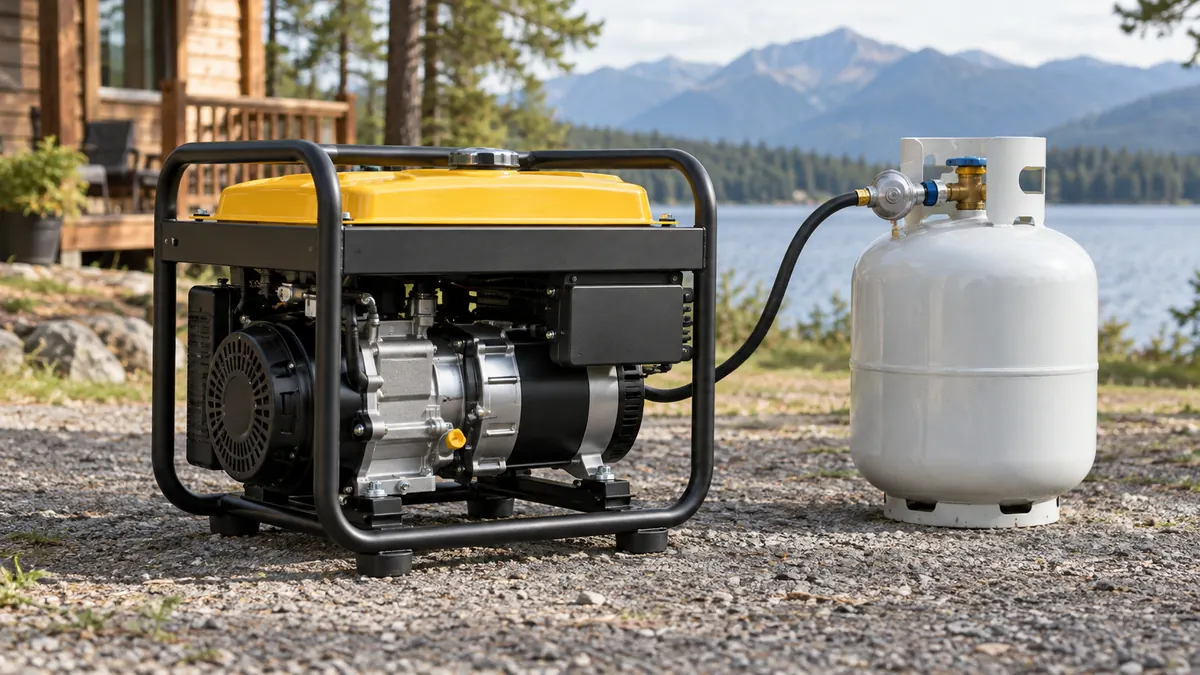
WGen12000DF ratings by fuel
- Manufacturer manual: 12,000 W running / 15,000 W peak on gasoline; 10,800 W running / 13,500 W peak on propane.
- The manual distinguishes the WGen12000DF and WGen12000DFc family variants; check the exact model plate and package.
- No exact active Amazon.com offer was verified for the configuration covered here, so no purchase box or live price is shown.
Official output and electrical ratings
| Specification | Gasoline | Propane |
|---|---|---|
| Running output | 12,000 W | 10,800 W |
| Peak/starting output | 15,000 W | 13,500 W |
| Voltage and frequency | 120/240 V, single-phase, 60 Hz in the manual reviewed | |
| Engine displacement | 713 cc | |
| Gasoline tank | 10.5 US gal (40 L) | |
| Fuel specification | Unleaded gasoline, 87–93 octane; no more than 10% ethanol | HD-5 propane |
| Starting method | Recoil, electric and remote start | |
| Oil specification | 1.6 L capacity; SAE 10W-30 listed in the owner manual | |
| AC grounding | Bonded to frame according to the owner manual | |
For this model, the propane rating is 1,200 W lower for sustained output and 1,500 W lower for starting output—about 10% below the gasoline figures in each case. A load list that falls between 10,800 and 12,000 running watts may fit the gasoline rating but exceed the propane rating; the same applies to startup demand between 13,500 and 15,000 W. Treat those ranges as a reason to recalculate, not as spare capacity. Appliance startup, outlet limits and operating conditions still matter.
The running figure is the starting point for sustained loads. Peak watts cover a short startup interval and do not mean the generator can deliver that output continuously. Westinghouse's manual also says output can be affected by altitude, temperature and fuel. For an actual unit, verify the model plate, manual revision and rated output on the appliance's fuel rather than using the larger gasoline figure when operating on propane.
Size circuits for gasoline or propane
Calculate the load using the rating for your chosen fuel and the startup draw of the largest motor. Confirm receptacles, voltage, cord, transfer equipment and fuel connection against the manual. The WGen12000DF is not a diesel option; keep that distinction in the URL copy and category before any publication decision.
Compare fuel, load and connection
- Use 12,000/15,000 W for gasoline or 10,800/13,500 W for propane; do not mix the columns.
- Confirm the exact DF or DFc panel, outlet labels and circuit limits before choosing cords or transfer equipment.
- For gasoline, follow the manual's 87–93 octane and 10%-ethanol maximum; do not use E15 or E85.
- For propane, use HD-5 fuel and the model-approved connection procedure and accessories.
A practical load-sizing method
Make a list of the loads that must run together, not every appliance in the building. Include heating, refrigeration, a sump or well pump, lighting and communication equipment as relevant. For each item, record its voltage and running watts. For motors and compressors, obtain the starting current from the equipment label, owner manual or manufacturer. Do not assume that a large peak rating removes the need to sequence starts.
- Add the continuous watts for the devices that will run at the same time.
- Identify the largest motor startup and compare it with the generator's fuel-specific starting rating.
- Check that each item matches an available receptacle and its branch-circuit limit.
- Plan which devices will be disconnected or switched off if a motor start causes a voltage drop or overload.
The total output rating is not the rating of each outlet. Circuit breakers, outlet combinations and voltage determine what can be drawn from an individual receptacle. The owner manual describes the AC grounding system as bonded to the frame; an electrician should check how the exact unit's grounding and neutral arrangement works with the transfer switch and installation. A fixed building connection requires transfer equipment selected and installed by a qualified electrician. Never feed a building circuit through a wall outlet or improvised double-ended cable; this can cause backfeed and serious injury.
Turn the fuel rating into a load worksheet
Before choosing gasoline or propane, write down the loads that must operate and the exact receptacles they will use. This keeps the comparison tied to the fuel-specific rating rather than the largest number in the product title. Use the generator manual and each appliance label; if a motor's starting demand is not published, ask its manufacturer instead of estimating it from the running wattage.
| Load-plan field | Record for the planned setup | Why it matters |
|---|---|---|
| Fuel in use | Gasoline or HD-5 propane | The running and starting ratings differ by fuel. |
| Appliance and nameplate | Model, voltage, phase and operating watts | The appliance must match the generator's electrical system. |
| Starting demand | Manufacturer-published current or surge requirement | Motors may need more power at startup than while running. |
| Connection point | Receptacle, breaker and transfer equipment | The whole-generator rating does not override an individual circuit limit. |
Then total the loads that will run together and identify which motor will start first. Keep sustained demand within the running rating for the selected fuel, and compare the largest startup demand with that fuel's peak rating. If the plan only fits on gasoline, do not assume it will also fit after switching to propane. Reduce simultaneous loads or have a qualified electrician review the circuit plan if any rating or connection is unclear. This is a planning check, not a substitute for the manufacturer's operating procedure or a commissioned installation.
Keep a copy of the worksheet with the generator's manual and label the planned setup with the exact fuel. If the propane cylinder, hose or regulator is changed, verify the replacement against the WGen12000DF instructions before operation; the product name alone does not confirm that a fitting is compatible. The same discipline applies to the DFc version, because Westinghouse publishes a separate owner manual for that identifier. Record which manual and document revision you used so a future operator can check the setup without guessing.
For an outage plan, separate loads that protect people or prevent damage from appliances that can wait. Note the order in which equipment should start, which item can be switched off during a motor startup, and who is authorized to operate the generator. If propane is the intended fuel, plan safe cylinder storage and refill access using local rules and the manual; do not estimate runtime from the gasoline tank capacity. Ask a qualified electrician to confirm the transfer arrangement and outlet allocation before connecting fixed circuits.
Regional fit and package limits
The manual identifies a North American 120/240 V, 60 Hz product and states that temperature, altitude and fuel affect available output. It estimates a power reduction of about 3.5% for each 1,000 feet above sea level and about 1% for each 10°F above 60°F. Those figures are manufacturer guidance, not a replacement for measuring a particular site's conditions. The 10.5-gallon tank capacity is not an autonomy claim: runtime depends on the selected fuel, load and conditions, and the manual's fuel-specific ratings do not predict how long a particular set of loads will run. These specifications do not establish suitability for a 230 V, 50 Hz installation or compliance with local electrical rules.
Check service details and conflicting THD documents
The WGen12000DF owner manual lists 1.6 L of SAE 10W-30 engine oil. Use the maintenance schedule and the correct manual for the exact suffix; oil capacity is useful for setup but does not replace checking the dipstick or following the level-check procedure. The quick-start guide groups the WGen12000DF and WGen12000DFc, while Westinghouse publishes separate owner manuals for those model identifiers.
There is also a specification discrepancy buyers should resolve before relying on power-quality claims: the WGen12000DF owner manual states total harmonic distortion of 5% or less, while the shared DF/DFc quick-start guide shows 23% or less. Because those documents do not agree, this guide does not present a single THD figure as settled. If a connected device requires a particular waveform or THD limit, ask Westinghouse to confirm the exact model, document revision and value for the unit being sold.
Compare fuel logistics and package contents
The manual's gasoline specification is for unleaded 87–93 octane with no more than 10% ethanol; it explicitly says not to use E15 or E85. Propane requires an HD-5 supply and the correct regulator, hose and connection. These differences affect outage planning and do not make the ratings interchangeable. Follow the manual for switching fuels and inspecting fittings; do not make a change while the generator is running unless its instructions explicitly allow that procedure.
Before buying, check whether the listing includes the battery, wheel kit, propane hose, remote-start accessories, oil and any advertised cable. Verify the full suffix: the WGen12000DF and WGen12000DFc are separate identifiers in Westinghouse documentation. Confirm the exact manual, replacement parts, local service and warranty for the unit's market. We have not verified an exact active Amazon.com offer for the configuration discussed, so this page does not display a purchase box or current price.
Outdoor placement and transfer setup
CDC's outdoor-only guidance applies to gasoline and propane engines: more than 20 feet from windows, doors and vents, never inside a home or garage, and use a battery-backed CO alarm. Follow the manual for fueling, grounding and electrical connections.