

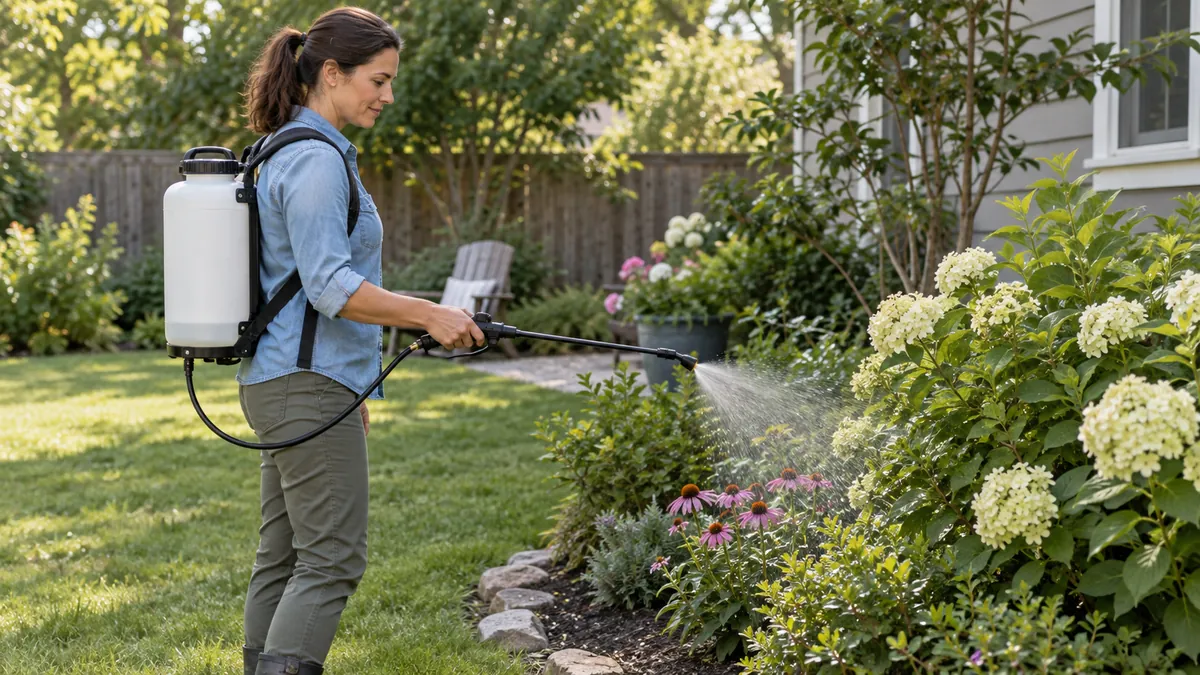
Choose the sprayer by task, not tank size alone
Handheld pump sprayers are convenient for a few containers, spot treatments, or small beds. They are easier to carry and rinse, but a small tank means more refills if the treatment area grows. Check the spray pattern and whether the unit is compatible with the liquid you plan to use.
Manual backpack sprayers put a larger tank on your back and use a lever to pressurize or operate the pump. They can reduce trips to refill on larger jobs, but the user supplies the pumping effort. A left- or right-side pump handle, strap adjustment, wand length, filter access, and replacement parts affect everyday fit.
Battery backpack sprayers power the pump from a rechargeable battery. They remove repeated pumping and can maintain pressure while the trigger is open, but they add charging, battery-care, and repair considerations. Read the exact model manual for chemical compatibility and battery use.
| Job | Type to compare | Before buying |
|---|---|---|
| A few pots or isolated spots | Handheld pump sprayer | Smallest useful capacity, easy rinsing, and a nozzle that matches the label directions. |
| Repeated treatment across a larger area | Manual backpack sprayer | Pump reach, hand preference, filtration, straps, and realistic full-tank weight. |
| Frequent work where repeated pumping is a burden | Battery backpack sprayer | Battery runtime stated by the maker, recharge time, available replacement parts, and chemical compatibility. |
Two 4-gallon backpack models compared
The two Chapin products below are different pumps in the same nominal tank class. Compare them as examples of battery and manual operation, not as winners. The Amazon listings were checked for model identity during this review; stock, package contents, and seller details may change, so confirm the exact model before ordering.
Chapin 63924 4-Gallon 24V Battery Backpack Sprayer
- ✓ Manufacturer-listed 4-gallon translucent tank and 24V rechargeable battery
- ✓ Up to 2 hours of continuous spraying stated by Chapin; actual runtime varies by use
- ✓ Three included nozzle types and three removable filters, per Chapin
- ✓ Check the current manual and product label for chemical compatibility and cleaning
No verified direct Amazon.com listing is linked for this exact model.
Chapin 61900 4-Gallon Tree & Turf Pro Manual Backpack Sprayer
- ✓ Four-gallon backpack model identified by the manufacturer
- ✓ Manual piston pump and stainless-steel wand, as specified for this model
- ✓ Manufacturer replacement parts are listed for the 61900 family
- ✓ Confirm the package, warranty, and chemical compatibility in the seller listing and manual
No verified direct Amazon.com listing is linked for this exact model.
The maker’s stated runtime for the 63924 is not a promise that every user will spray for two hours in one session. Flow, nozzle setting, trigger time, and battery condition change what a charge covers. Likewise, a manual sprayer’s listed capacity does not tell you how many square feet one tank treats; that depends on the label rate, application technique, and calibration.
Estimate capacity, filled weight, and refills
Water weighs about 8.34 pounds per US gallon. A four-gallon tank therefore holds about 33 pounds of water before adding the sprayer, battery, wand, and straps. A five-gallon tank holds about 42 pounds of water alone. This simple estimate can rule out a backpack that would be uncomfortable when full. You can fill less than the maximum, but keep the liquid level within the manual’s instructions and make sure the unit remains balanced.
Do not use tank capacity as a coverage claim. Calibrate with clean water on a measured area using the same nozzle, pressure, walking pace, and wand movement you plan to use. Record the volume applied. If the product label specifies an amount per area, use the measured output to calculate the mix for that area. Penn State Extension describes both a square-foot and an acre method and emphasizes consistent technique.
Consider the refill process too. A wide opening and filter basket can help keep debris out during filling; a translucent tank makes it easier to see the level. Make sure you can safely lift the tank to fill it, or choose a smaller handheld model for work where the larger pack would be awkward.
Match the nozzle and calibrate with water
Nozzle pattern controls where liquid goes and how evenly you can cover the target. A flat fan, adjustable cone, and stream serve different application patterns. Match the nozzle to the product label and the sprayer manual; do not assume that a finer mist is more effective. Fine droplets can travel off target more easily in wind.
- Choose a measured test area similar to the real job.
- Fill with clean water and select the nozzle and operating setting you intend to use.
- Walk at a steady pace and keep the wand movement and distance consistent.
- Measure the water used or collected, then repeat if the result varies.
- Use the measured output with the exact label rate; do not guess a concentration from tank size.
Keep a calibration note you can repeat
Write down the sprayer model, nozzle, pressure or pump setting, test-area size, water used, walking pace, and wand movement. That record helps you repeat an application consistently and shows which condition changed if the result looks different next time. Penn State Extension’s calibration guidance uses measured area and output for this reason; it does not replace the product label or approve a chemical mixture.
Calibrate again with clean water if you change the nozzle, repair a leak, clean a filter, alter the pressure setting, or switch to a different application technique. If output becomes uneven, first inspect the nozzle, strainer, hose, seals, and battery or pump operation according to the manual. Do not compensate for a blocked or worn part by mixing a stronger solution. Keep the label rate and permitted application conditions as the limits for any treatment.
Apply products safely and avoid drift
For pesticides, the label governs where, how, and when a product may be used, along with protective equipment and re-entry directions. Read it before filling the tank. EPA notes that spray drift can expose people, wildlife, plants, and water; apply only to the treatment area and account for wind, nearby sensitive places, drains, and surface water. Avoid conditions the label prohibits.
Do not mix products unless each label allows it. Label the sprayer with the product or use, keep it away from children, and avoid pouring or rinsing concentrate near a drain. When the label calls for rinsing equipment, direct rinse water to the treated area as allowed by the label and local rules; prevent it from reaching a storm drain or waterway.
Before filling, walk the treatment area and identify nearby gardens, drains, ponds, open windows, pets, and people. The EPA describes drift as movement of pesticide away from the intended site, so choose only conditions and equipment permitted by the label, keep the spray directed at the target, and stop if wind or the setup makes that difficult. A more powerful pump or finer mist does not make an off-target application acceptable.
Clean and store the sprayer after use
Empty the tank safely and clean it according to the chemical label and sprayer manual. Chapin advises cleaning its 63924 after each use, not storing chemicals in the sprayer, and notes that using multiple chemicals in one sprayer can cause cross-contamination even after cleaning. Inspect the seals, hose, wand, nozzle, and filters for leaks or debris before the next use. Store the unit dry and protect batteries from unsuitable temperature or moisture, following the model instructions.
If the liquid you plan to spray is not clearly covered by the manual, contact the manufacturer before putting it in the tank. Chemical compatibility depends on the liquid, concentration, seals, and sprayer materials. A manufacturer’s general “chemical-resistant” description is not approval for every formulation.