

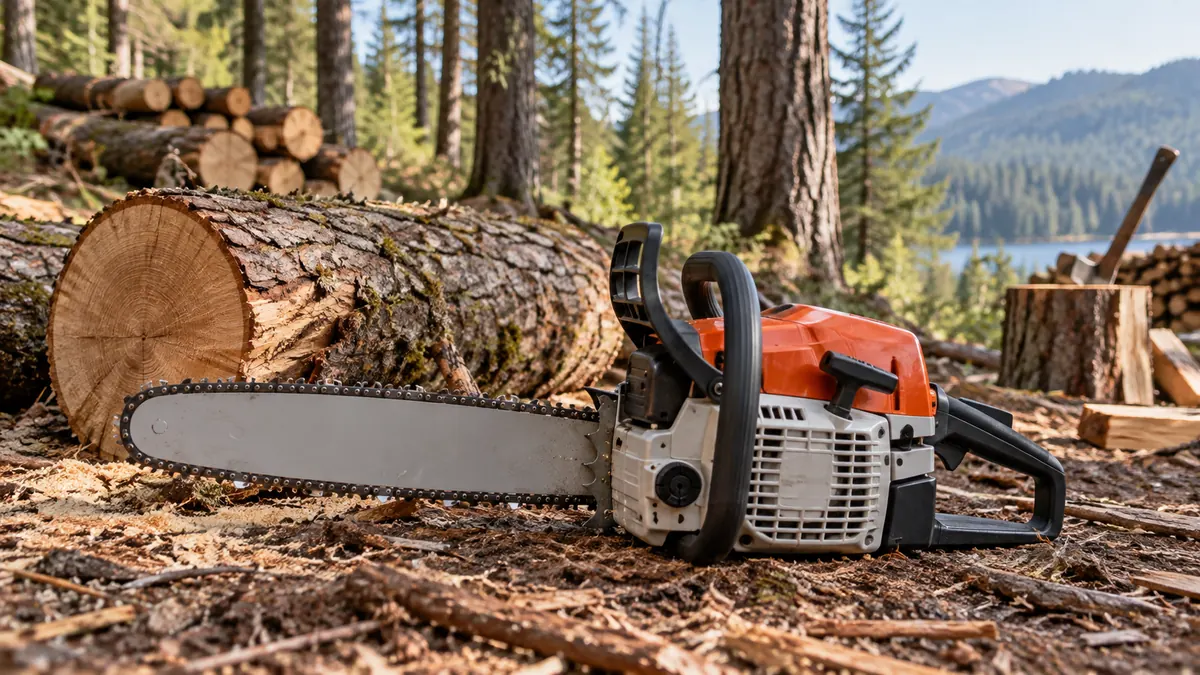
Husqvarna 135 and 135 Mark II are different generations
The product name alone is not enough to confirm which saw a listing or used machine refers to. The older 135 has its own manual and parts list; Husqvarna’s 2025 operator manual covers the 130 and 135 Mark II as a later product family. Even where the saws look similar, do not transfer engine data, starting instructions, bar fit or service parts from one generation to the other.
The comparison below uses two specific regional records: the older 135 article listed by Husqvarna UK and the US 135 Mark II configuration. It should not be read as a universal comparison for every country, model year or package.
| Manufacturer record | Older 135, UK article 966 76 18-02 | 135 Mark II, US SKU 967 86 18-16 |
|---|---|---|
| Status in linked support page | Marked discontinued | Support page says currently available |
| Displacement | 40.9 cm³ | 38 cm³ |
| Published output | 1.5 kW | 2.1 hp |
| Weight, excluding cutting equipment | 4.4 kg | 10.36 lb |
| Bar and chain record | 35 cm bar; H37 chain, 3/8-inch mini pitch | 16-inch setup; S93G, 3/8-inch mini pitch, .050-inch gauge |
These values come from different market pages and are not a test under identical conditions. The older 135 page describes a European 14-inch setup; the US Mark II configuration lists a 16-inch setup. Use them to distinguish the records, then use the exact manual and product plate for the saw in front of you.
Specifications by product number and market
For US SKU 967 86 18-16, Husqvarna lists 38 cm³ displacement and 2.1 hp output shaft power. The page identifies a 16-inch bar and S93G chain. Its equipment table gives a recommended 14–16-inch bar range, 3/8-inch mini pitch and .050-inch gauge. Husqvarna lists the machine at 10.36 lb excluding cutting equipment; that is not the weight of a complete saw with bar, chain, fuel and oil.
For older UK article 966 76 18-02, the support page gives 40.9 cm³, 1.5 kW, 17.1 m/s chain speed and 4.4 kg excluding cutting equipment. It lists a 35–40 cm bar range and H37 chain. These figures belong to that support-page configuration and should not be copied into a 135 Mark II listing.
Husqvarna’s 2025 Mark II manual is the primary reference for assembly, fuel, starting, adjustment, maintenance and safety. The manufacturer's support pages can show different SKU configurations, so match both the product number and the region. If a seller gives different specifications, request a clear photograph of the data plate and the included manual before purchase.
How to identify the exact saw before ordering parts
- Read the data plate. Record the full product or article number and serial information. “135” or “135 Mark II” in a listing title is not enough to establish a match.
- Find the matching support page. Select the product number in Husqvarna support, then download the manual and illustrated parts list for that generation.
- Compare the supplied configuration. Note the bar length, chain type and package contents. A bare saw and a saw sold with a bar, chain or case can have different included equipment.
- Check regional details. Fuel, emissions labels, warranty coverage and dealer support can depend on the market where the machine was sold.
- Ask an authorised dealer if records conflict. Do not fit a part based only on a product photo or a search result for a similar model.
This procedure is especially useful for used machines, clearance stock and retailer listings that combine several variants on one page. Keep the product number and serial record with the receipt and manual so future parts searches start from the exact configuration.
Bar and chain compatibility checks
Bar length is only one part of a compatible cutting set. Chain pitch must match the drive sprocket and bar nose; gauge must match the bar groove; and the number of drive links must fit the installed bar. The mount and tensioner must also be correct for the saw. Husqvarna lists H37 for the older 135 page and S93G for the specified US Mark II configuration, so the chain names should not be treated as interchangeable.
Before ordering, read the markings on the guide bar and compare them with the operator manual. If the bar has been replaced, use the bar maker’s identification and compatibility information too. A chain that is too loose can derail; one with the wrong pitch or gauge will not seat correctly. Stop if the markings are missing or inconsistent, and have a service dealer identify the parts before operation.
Follow the manual for chain tension and lubrication checks, and switch off the engine before inspecting or adjusting the cutting equipment. A new chain can stretch during initial use; use only the re-tensioning procedure in the matching manual. Never rely on the saw’s family name alone to select a file, chain or bar.
Decide whether this gas chainsaw fits the work
A gas chainsaw may suit work that takes place away from a power outlet and involves repeated cuts, but it also needs fuel, chain oil, engine maintenance, noise management and safe outdoor operation. Decide what you will cut, how often, where the machine will be stored and whether a local dealer can service the exact generation. For occasional pruning near a home, a lighter battery or corded tool may be easier to manage; compare the actual task and material rather than relying on a generic “best for firewood” claim.
Neither engine displacement nor bar length sets a safe maximum log diameter. Wood species, knots, tension, support, chain condition, operator position and experience all change the cut. Avoid using a homeowner saw for tree felling, storm-damaged limbs, elevated work or wood under compression unless you have the required training and controls. For uncertain or hazardous work, use a qualified professional.
For ordinary ground-level bucking, plan stable support and keep the work area clear of people and obstacles. Do not cut with the bar tip, force the saw through a binding cut or allow the chain to contact soil or hidden metal. The operator manual and training govern safe technique; this page only helps compare product records and does not teach felling.
Availability, warranty and local service
Husqvarna UK marks the older 135 support page as discontinued while continuing to provide manuals, parts information and listed accessories. Husqvarna US describes the 135 Mark II support record as currently available and links it to the current product page. These labels apply to those regional sites; they do not establish stock or warranty terms in another country.
The US product page shows SKU 967 86 18-16 and a US retail price at the time of this review, but we have not confirmed a current exact Amazon.com offer for that SKU. There is no Amazon box or price claim on this page. If purchasing through a dealer, confirm the product number, bar and chain included, delivery terms, warranty territory and access to an authorised service centre.
Before buying a discontinued or used 135, ask whether the dealer can still source the parts needed for the actual job. Check the chain brake, throttle lockout, catcher, handles, tensioner and oiling system as permitted by the manual. A parts listing does not prove that every item is in stock; ask the service centre for availability and compatibility by product number.
Manual-led operation and safety limits
Husqvarna's Mark II manual calls for reading the instructions, using the saw with both hands and keeping bystanders clear. It warns against operating the product in a tree or on a ladder and says not to start it indoors or near flammable material. Follow the manual for PPE, chain brake, starting, fueling, maintenance and transport. A generic video or procedure for an older 135 may not apply to the Mark II.
Wear the protective equipment required by the manual and local rules, including eye, hearing, hand, leg and foot protection suitable for chainsaw work. Keep the chain brake and other safety devices in working condition; do not modify or remove them. Refuel outdoors with the engine stopped and cooled as directed by the manual, and keep fuel away from sparks, flames and occupied indoor spaces.
If the brake fails, the chain runs at idle, the saw leaks fuel, a handle is damaged or vibration changes suddenly, stop using it and contact an authorised service provider. This guide does not replace training, the product manual or a site-specific risk assessment.