

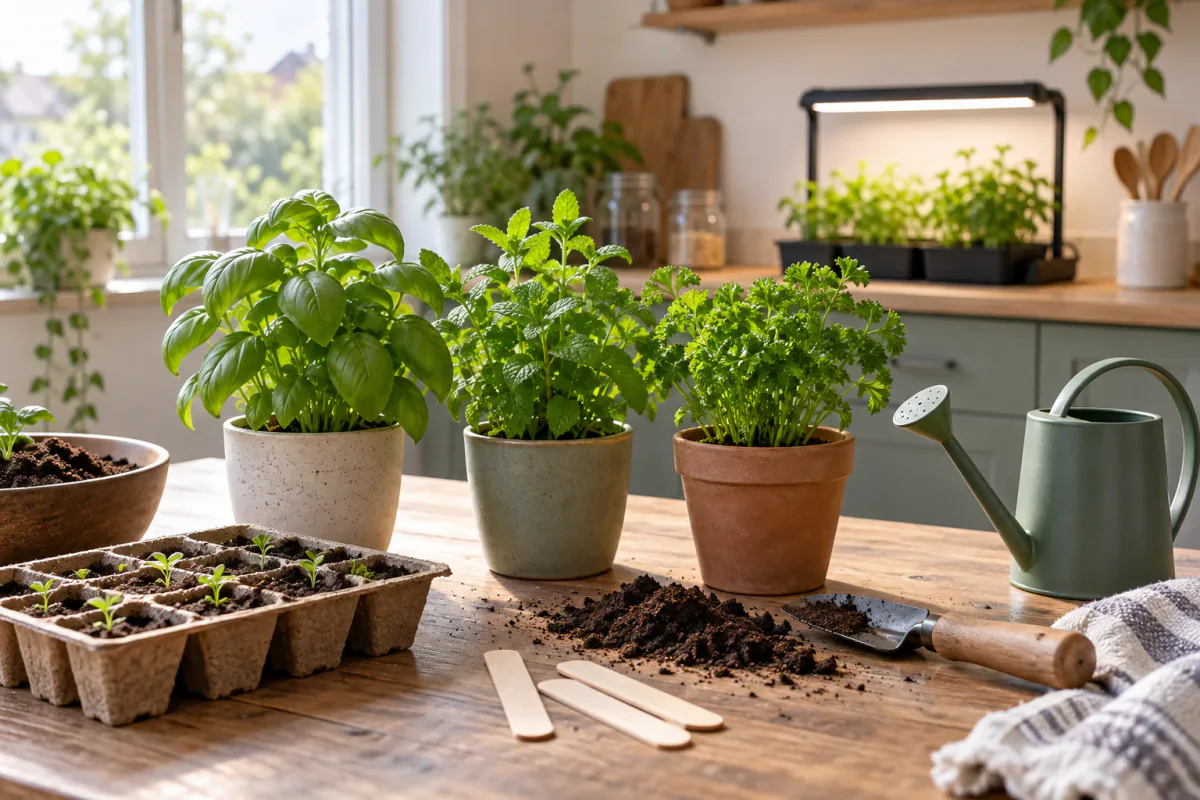
Choose the type of herb garden kit
First decide what you want the kit to do. A seed kit starts plants from scratch; a live-plant kit gives you established herbs; a hydroponic system uses a reservoir or other water-based setup. These options differ in setup time, equipment, replacement needs and how much control you have over the varieties.
Decide which herbs you will actually use, then check their growing requirements. A kit that includes several varieties is not automatically a better fit if you have room or light for only a few. Penn State Extension’s guide to growing herbs indoors explains the importance of light, drainage and suitable containers.
Compare what each kit includes
| Kit format | Verify before ordering | Ongoing consideration |
|---|---|---|
| Seeds and starter tray | Seed names, sowing instructions, tray cells, drainage and included medium | Germination conditions, thinning and transplant pots may be needed |
| Live starter plants | Plant identity, pot condition, delivery timing and handling instructions | Check whether each plant needs repotting and whether its water needs match |
| Water-based system | Reservoir, pump or light components, setup guide and electrical details | Confirm which replacement parts or nutrient supplies are required |
| Pot set | Usable pot size, drainage holes, saucers and labels | Check whether growing medium and seeds or plants are actually included |
Read the itemized description and care instructions; staged product photographs can show accessories that are not included. Check whether the kit requires separate growing medium, a light, fertilizer or replacement inserts.
Check light, space and ongoing supplies
Measure the windowsill, counter or shelf and note how much usable light the site receives. Indoor light depends on window direction, season, glazing, curtains and nearby buildings. Do not assume that a south-facing window or an included lamp suits every plant; compare the species’ needs with the setup instructions. Oregon State University Extension’s indoor herb guide discusses practical light and watering considerations.
Check the ongoing cost and availability of any proprietary pods, nutrient solution, filters or replacement components. For a simple soil setup, confirm that pots drain and that excess water can be caught. See our guides to potting mix and plant pots if you are assembling a kit yourself.
Set up the kit and watch the first weeks
Before opening seed packets, identify each variety and read the sowing instructions. Label containers, assemble the system on a stable surface and test its drainage or reservoir for leaks. Start with the recommended number of plants rather than filling every space; overcrowding can make light, airflow and harvesting more difficult.
For the first weeks, record germination or new growth, watering and the light conditions. Check moisture directly instead of relying on a generic calendar. Remove dead leaves, inspect for pests and adjust the position gradually if growth leans toward a window. Culinary herb cultivation advice does not apply to medicinal uses; use plant-specific horticultural sources for growing conditions.
Decide whether a kit is worth it for you
A kit can save time when its included containers, labels and instructions suit your chosen herbs. Buying components separately may be simpler if you already have pots, want only one or two plants, or need varieties the kit does not contain. Compare the contents and future replacement needs rather than paying for parts you will not use.
For variety selection and growing advice beyond the purchase decision, continue to our aromatic plants guide.
Choose herbs that suit the kit and your kitchen
Pick a short list of herbs you cook with, then check whether the kit can grow them in its actual location. A kit’s seed assortment may not suit a dim windowsill or a cool room. Penn State Extension notes that basil needs warmth and bright light, while its indoor-herb guide lists chives and cilantro among alternatives that can tolerate lower light in that regional context. Use those profiles as a starting point and check the variety label for local timing and growing conditions.
| Herb | Question for the kit | What to plan for |
|---|---|---|
| Basil | Can it provide warmth and strong usable light? | It is sensitive to cold; do not place on a chilly winter sill without checking conditions |
| Chives | Is there room to trim and harvest leaves? | Leave space for the plant to grow and follow local light guidance |
| Cilantro | Does the kit support the seed or starter form included? | Check sowing and harvest instructions for the specific variety |
| Mint | Can it have a separate container? | RHS recommends giving mint its own pot because it can spread among neighboring plants |
Do not combine plants solely because a kit sells them together. The RHS guide to herbs in containers describes differences between herbs that prefer drier conditions and those needing more moisture. A kit with separate pots can make it easier to adjust care for each one.
Check running costs and replacement parts
Before comparing prices, list everything the product does and does not include. A seed kit may require separate pots and medium as seedlings grow; a live kit may need repotting; a water-based system can rely on replacement inserts, nutrients, pumps or a grow light. Find out whether those parts are standard or proprietary, how they are replaced and whether instructions remain available after purchase.
Estimate the space as well as the money. Measure the system with its lid or lamp installed, leave room to reach the reservoir, and check that cords and water remain safely separated. If the kit uses a light, look for documented setup and maintenance instructions rather than judging by product photography alone. Make sure the shelf or counter can support the complete setup and that splashed water can be wiped up.
Consider the waste and storage created by seed packets, plastic inserts and nutrient bottles. A small kit that matches your routine may be more useful than a larger assortment that is difficult to maintain. Compare the kit with a DIY setup using suitable pots, labels, medium and seed or starter plants.
Use a step-by-step setup checklist
- Confirm the exact contents, plant names, growing medium and any required extras.
- Read instructions for sowing, drainage, light, watering and replacement components before opening the kit.
- Choose a stable location with suitable light and access for watering and harvesting.
- Check that pots drain and that runoff will not reach electrical equipment, furniture or the floor.
- Label varieties with their names and start dates so you can compare growth.
- Start with the recommended number of seeds or plants; do not fill every space if it creates crowding.
For a soil kit, use a medium labelled for containers and follow any pre-moistening instructions. For a water-based system, test the reservoir for leaks and learn how to clean and refill it. Keep the original instructions and a photo of the label for later reference.
Troubleshoot the first month of growth
| Observation | Check first |
|---|---|
| Seeds have not germinated | Seed age, sowing depth, temperature and whether the medium stayed evenly moist |
| Seedlings stretch toward a window | Whether the kit position gives adequate light and whether the lamp is set as instructed |
| Leaves yellow or growth slows | Moisture, drainage, root space and variety-specific needs |
| Surface develops algae or stays wet | Watering frequency, airflow and drainage or reservoir level |
Change one condition at a time and compare the plant’s response with its instructions. Do not increase fertilizer or water simply because growth looks slow. For more detailed advice on container herbs and indoor light, use the Penn State and Oregon State Extension sources linked above and our aromatic plants guide.
Check whether the instructions are specific enough
Good kit instructions identify each plant and give the setup steps for that format. For seeds, look for sowing depth, spacing, temperature notes and guidance on thinning or transplanting. For live plants, check acclimation, initial watering and whether the roots should be moved to another pot. For a water-based system, the instructions should explain reservoir level, cleaning, light setup and how to identify a pump or nutrient issue.
Be cautious with exact harvest timelines in advertising. Germination and growth depend on the variety, temperature, light, water and season; a kit cannot guarantee the same result in every home. Prefer instructions that explain what to observe and how to adjust rather than promising a fixed amount of harvest from a particular date.
Check whether care information is still available after ordering. Keep a digital copy or photograph of the plant list and setup guide, especially if it includes proprietary replacement parts. If the instructions do not explain a chemical, fertilizer or pest-control product, do not use it on herbs intended for food without verifying the label’s allowed use.