

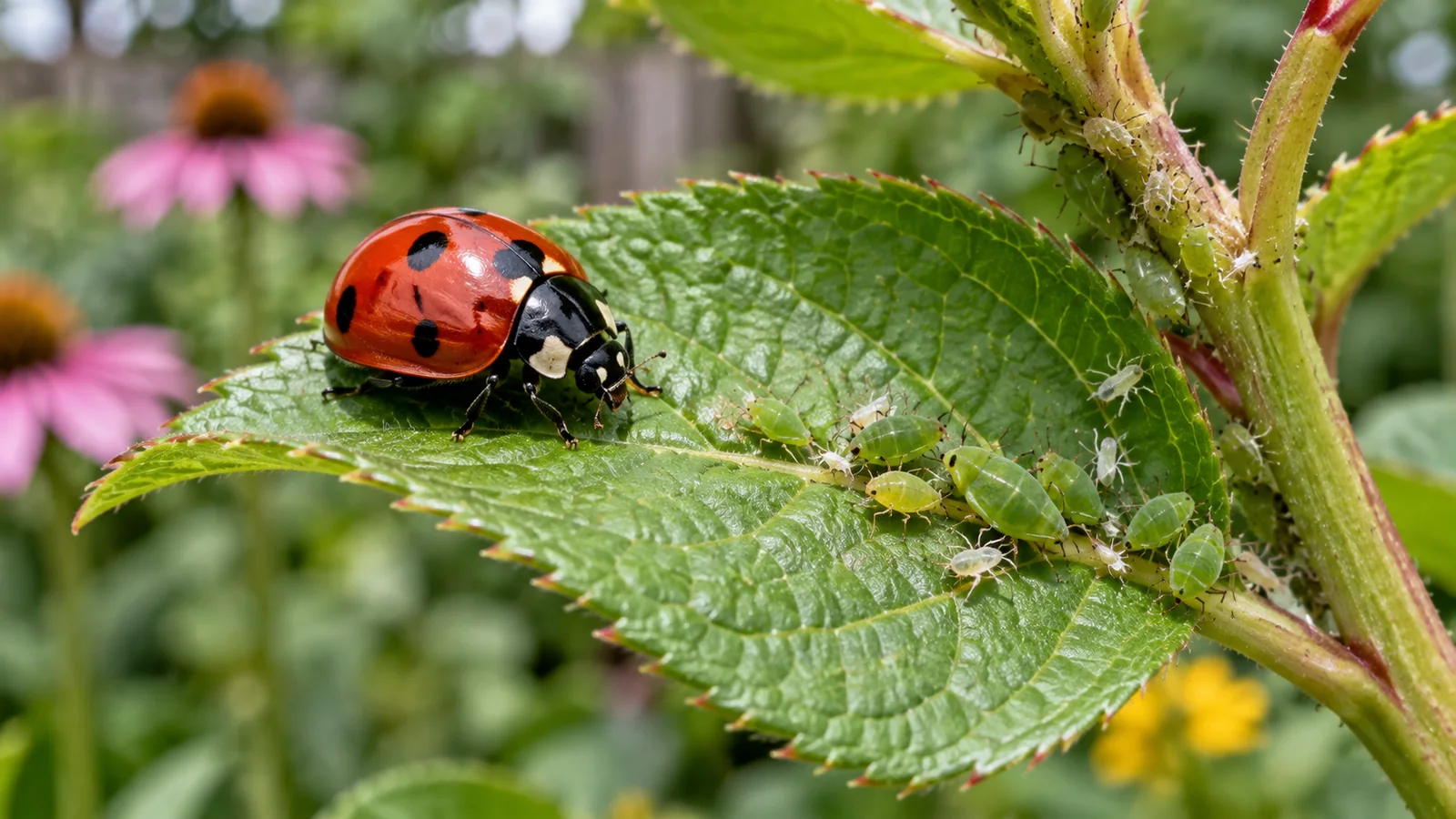
What biological control can and cannot do
Biological control uses predators, parasitoids or microorganisms to suppress a particular pest. It works only when the control agent matches the pest and conditions; it is not a guaranteed, immediate or self-sustaining cure. Start by identifying the pest and deciding whether its damage justifies intervention.
In a home garden, conserving resident beneficial insects is often more practical than releasing purchased insects: provide regionally suitable flowering plants and shelter, tolerate low pest numbers where plants are healthy, and avoid unnecessary broad-spectrum pesticides. A release may disperse or fail when prey, climate, crop or timing is unsuitable.
Beneficial insects: match the agent to the pest
Lady beetles, lacewings, hoverfly larvae and parasitoid wasps may feed on or parasitize certain pests. Their presence does not prove an outbreak will be controlled. Identify both organisms before deciding whether to conserve or purchase a biological control, and verify that the pest and crop match supplier or Extension guidance.
Flowering resources can support some adult beneficial insects, but plants that attract natural enemies do not guarantee pest suppression. Avoid pesticide use around active beneficials unless the label and evidence support it.
Beneficial nematodes: check target and conditions
Beneficial nematode products target certain soil-dwelling insect stages; species are not interchangeable. Confirm the pest, nematode species, soil temperature and moisture requirements, storage conditions and application instructions in the product documentation. Performance can fail if organisms are mishandled or conditions are unsuitable.
Do not assume a general “beneficial nematode” product controls any grub, gnat or weevil. Use a local Extension diagnosis and the exact supplier instructions.
Microbial controls: distinguish Bt from spinosad
Bacillus thuringiensis (Bt) products differ by strain and target. Bt kurstaki products are used for certain susceptible caterpillars, so non-pest butterfly and moth larvae can also be exposed if they eat treated foliage. Keep applications off flowers and non-target host plants and follow the exact label.
Spinosad is a separate active ingredient, not a Bt product. It can harm bees and other beneficial insects under label-described exposure. Do not infer pollinator safety from “organic” or “biological”; check the product label and EPA guidance before use.
See the EPA garden pesticide guidance and USU Extension’s integrated pest and pollinator guidance.
Support beneficial insects without promising control
Choose regionally suitable flowering plants with overlapping bloom periods, provide varied plant structure and avoid unnecessary broad-spectrum pesticide use. These steps can provide food or shelter for some beneficial insects, but the species that arrive and their effect on pests depend on location, season and habitat.
Before using a purchased release, verify the organism’s identity, target pest, release conditions and pesticide compatibility with the supplier and local Extension service. Do not release organisms outdoors unless lawful and appropriate for the area.
A practical decision sequence
- Photograph damage and identify the pest or ask Extension for help.
- Check whether damage is continuing; some insects are harmless or naturally decline.
- Look for existing predators or parasitoids before buying a release.
- Match any selected control to the pest, crop, life stage and label or supplier instructions.
- Monitor the plant and record whether damage is increasing; change course only with evidence.
This page is a starting point, not a species-by-species release recommendation. Use a regional diagnostic service for identification and locally appropriate control.
Decide whether to conserve or release a control agent
“Biological pest control” can describe several different actions. Conservation supports organisms already present; augmentation releases natural enemies that are raised elsewhere; microbial products introduce or apply a specific pathogen. These approaches have different costs, timing, and risks. First decide what problem you are solving and whether the damage is still increasing.
| Approach | What it involves | Useful question before choosing |
|---|---|---|
| Conservation | Protect resident predators and parasitoids by limiting unnecessary broad-spectrum pesticide exposure and providing suitable habitat | Are beneficial insects already present, and can the garden tolerate some pest activity while they respond? |
| Augmentation | Purchase and release an identified beneficial organism under specified conditions | Does the species target this pest and life stage, and can the site retain it after release? |
| Microbial product | Apply a labeled bacterial, fungal, viral, or other microbial control to a stated crop and pest | Does the label identify the pest, crop, application timing, weather limits, and non-target precautions? |
| Physical or cultural control | Remove infested material, exclude pests, or adjust crop conditions where practical | Can this reduce the problem without harming the plant or disrupting beneficial organisms? |
Biological control belongs within integrated pest management, where identification, prevention, monitoring, and proportionate intervention come before selecting a product. A low pest count on a healthy plant may not justify a release or spray. If the pest is damaging a high-value crop or spreading rapidly, combine reliable diagnosis with local Extension advice instead of waiting for an agent that may not be present or active.
The Utah State University Extension integrated pest and pollinator resource is a framework for protecting beneficial organisms while managing pests. Adapt its guidance to the crops, species, climate, and product rules in your area.
Match biological control to the garden setting
The same natural enemy can perform differently in a greenhouse, a high tunnel, and an open garden. Before ordering a release, check the organism’s scientific name, target pest, release stage, temperature and humidity range, storage requirements, and supplier instructions. Verify that the pest is present at the life stage the agent can use as food or host.
- Open garden: adults or mobile agents may disperse, and wind or rain can alter activity. Habitat can support resident natural enemies, but it cannot guarantee that the desired species arrives in sufficient numbers.
- Greenhouse or enclosed space: a more contained environment may make release timing easier to manage, but temperature, crop density, pesticide residues, and ventilation still affect survival.
- Soil-dwelling pest: match nematode or other biological products to the pest species and susceptible stage. Check soil conditions, application water, storage, and shelf life in the exact product directions.
- Leaf-feeding caterpillar: a microbial product may affect non-target caterpillars that feed on treated foliage. Identify the pest and host plant, protect non-target species, and follow label restrictions.
These are screening questions, not a universal species-to-pest chart. Product formulations and organisms vary, and a trade name alone may not identify the active agent or its target. Ask the supplier or Extension service to confirm the exact match. Do not introduce organisms outdoors unless their use is legal and appropriate for the region.
Measure results and protect non-target species
Before intervention, take clear photographs and record where the pest appears, what plant is affected, and whether damage is increasing. After using a biological control, repeat the same observation and compare the number of affected leaves or visible pests. Record weather, release or application date, and the instructions followed. Monitoring helps distinguish a real change from a temporary impression.
Do not judge success only by whether every pest disappears. A biological agent may suppress a population without eliminating it, and some plant damage cannot be reversed. Set a practical threshold for action with local Extension guidance, especially for edible crops, seedlings, or valuable collections.
Protect pollinators and other non-target organisms by identifying what is flowering and active before any product is applied. Read the complete EPA-approved label, including restrictions about bloom, drift, re-entry, water, and timing. The EPA’s garden pesticide label guidance explains why the label determines lawful use. “Biological” and “organic” describe neither a guaranteed result nor universal safety.
If the pest continues to increase, reconsider the identification, the life stage, and whether conditions suit the chosen agent. Seek a new diagnosis before escalating to another product. A careful change based on monitoring protects beneficial species and makes the next decision more informed.
Apply the framework to common garden situations
Examples show how to ask the right questions; they are not universal treatment instructions. Pest species, crop, climate, product labels, and local law determine whether an option is appropriate.
| Situation | First biological-control question | What to verify before acting |
|---|---|---|
| A few aphids on a healthy ornamental | Are predators or parasitoids already present, and is plant damage increasing? | Whether the plant can tolerate monitoring or a physical rinse before buying a release |
| Caterpillars on a crop or ornamental | Is the larva a plant pest or a non-target butterfly or moth? | The exact Bt strain, target pest on the label, crop, and risks to other caterpillars feeding on treated foliage |
| Suspected grub or other soil insect | Which pest and life stage are present in the soil? | The nematode species or other agent, soil temperature and moisture, storage, and application instructions |
| Pest outbreak in a greenhouse | Can a suitable natural enemy establish in this crop and protected environment? | Supplier release rate and timing, temperature, humidity, pesticide residues, and the ability to monitor populations |
For example, seeing aphids does not automatically mean that lady beetles should be purchased. First check whether the aphid population is small or causing continuing damage and whether predators are already feeding. A release may disperse if prey is scarce or the site cannot retain the insects. The practical decision may be to observe, remove a small colony, or adjust the plant’s growing conditions.
For caterpillars, a product described as a biological control still needs accurate identification. Some Bt formulations target susceptible caterpillars and can expose non-pest larvae if they feed on treated leaves. Treat only when the label and local advice support the use, and protect host plants intended for pollinators or other wildlife. For soil pests, confirm the organism and life stage before ordering nematodes; the word “beneficial” does not identify the product’s target.
Use a written note of the pest, affected plant, evidence of damage, chosen agent, release or application conditions, and result. If the plan depends on a species-level pest identification or a product claim that you cannot verify, pause and ask Extension or the supplier for documentation. This prevents spending on a natural enemy that cannot reach or use the target pest.
Choose a biological control only after identifying both the pest and the control agent. Confirm the target species, life stage, release conditions and whether the organism will remain in an open garden or is better suited to a greenhouse. A diverse supply of nectar, pollen and shelter can support naturally occurring beneficial insects, but it does not guarantee a pest will be controlled. Utah State University Extension explains these habitat needs in its companion-planting guidance and integrated pest and pollinator management guide.