

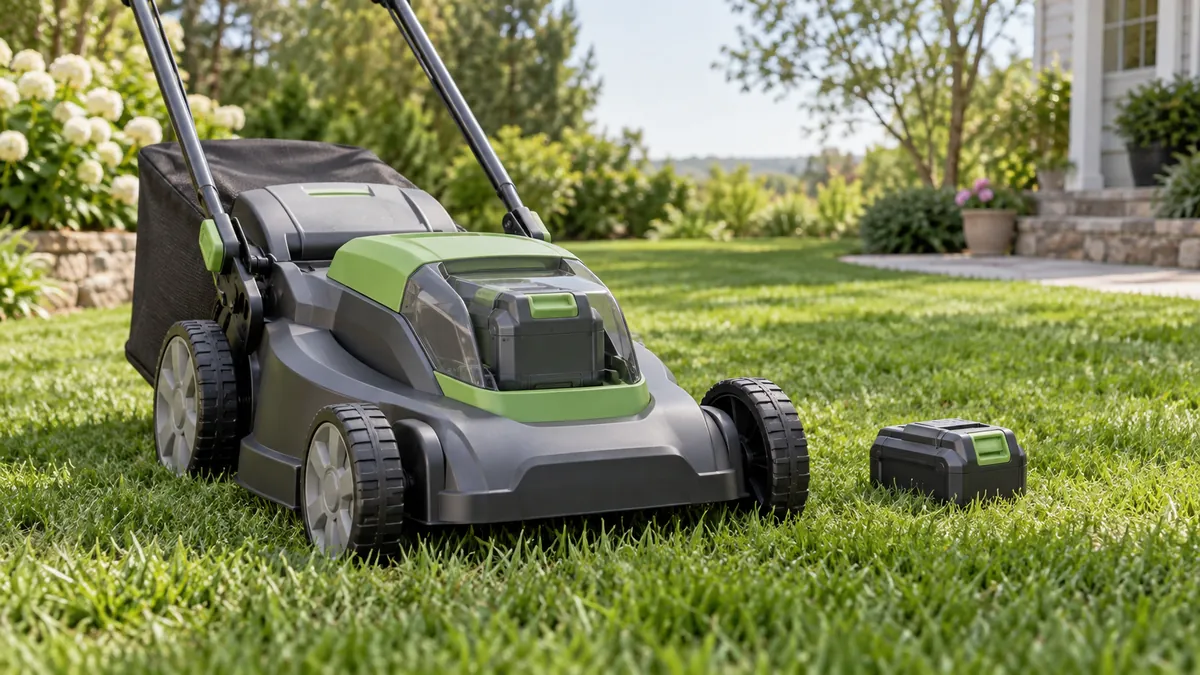
Start with the lawn, not the battery voltage
Measure the sections that need mowing rather than using the size of the whole property. Exclude patios, beds and paths, then note whether separate grass areas are connected by a passage. Record slopes and tight turns too: a mower may be rated for a certain area while a complicated layout takes longer to cover than an open rectangle.
Make a shortlist using the manufacturer’s coverage guidance for the exact model and included battery. Do not treat a marketing estimate as a promise. The maker’s test conditions may differ from your grass height, cutting height, terrain, temperature and mowing interval. If the lawn is near the upper limit, compare the cost and compatibility of an additional battery before buying.
| Lawn condition | What to verify | Why it matters |
|---|---|---|
| Open and mostly flat | Coverage guidance and deck width | A wider deck may reduce passes, but confirm it fits storage and access. |
| Slopes or uneven ground | Drive type, handling and manual limits | The operator must be able to control the mower safely on the actual terrain. |
| Long grass or infrequent cuts | Manufacturer guidance for heavy cutting | Dense, tall grass can use more energy and may require staged cutting. |
| Several small sections | Carry points, folding handle and battery swaps | Moving between areas and storing the mower may matter more than deck width. |
Check the battery and charger included
Product listings may describe the same mower as a complete kit or as a bare tool. Before comparing prices, check the model number, battery capacity, charger, grass catcher and any side-discharge or mulching parts in the package. A bare tool is useful only when you already own a battery and charger approved for that exact product family.
Do not assume that packs with the same voltage or brand name are interchangeable. Compatibility can depend on the platform generation and connector. Check the manufacturer’s compatibility page or the manual, including whether a mower accepts one or more batteries and whether the charger is supplied.
Match deck width, height and collection
Deck width affects how many passes a mower needs, but the widest deck is not automatically the easiest choice. Measure gates, shed doors and the narrowest route to the lawn. A slightly narrower mower can be easier to turn around beds and store; a wider one may suit a larger open area if it fits through access points.
Check the available cutting-height range and how it is adjusted. The right height depends on the grass species, season and local climate, so use an extension guide for lawn care and the mower manual for the machine. The University of Minnesota Extension advises maintaining sharp blades and explains how cutting height and leaving clippings affect lawn health. Bagging, mulching and side discharge are separate functions; verify which are included rather than assuming every mode comes in the box.
Understand runtime without trusting a single number
Runtime claims describe a particular test, battery and workload. Your result can change with grass height and moisture, slope, blade condition, cutting mode, temperature, battery age and how often the mower stops or turns. Use manufacturer data to compare models tested on the same basis, then leave room for variation instead of planning around a single best-case figure.
If you need longer sessions, check whether the maker offers a compatible higher-capacity pack or a second-battery system. Consider charging time and whether you can safely keep a spare battery indoors according to its instructions. A second battery is only a useful solution when it is compatible and the mower’s design supports the intended use.
Turn the lawn map into a battery plan
Use a short planning worksheet before comparing battery sizes. Measure each grass section, mark gates and turns, and note whether you normally cut dry grass at a regular interval or wait until it is tall. Then compare your notes with the manufacturer’s coverage figure for the exact battery included. If the documentation gives only runtime, ask whether that figure was measured while cutting or with the mower running unloaded; those are not equivalent workloads.
| Record | How to use it |
|---|---|
| Mowable area by section | Compare only the grass the mower can reach, not the whole plot. |
| Access width and storage path | Check deck width, handle folding and how far you must carry the mower. |
| Normal mowing interval | Longer or less frequent cuts can increase the load; follow the maker’s guidance for tall grass. |
| Battery and charger in the box | Price a complete kit before comparing it with a bare tool or another platform. |
| Recharge time and second-pack plan | Decide whether one session, a charging pause or an approved spare pack suits your routine. |
If the lawn sits near the product’s stated upper coverage, avoid assuming that a larger battery alone will solve the fit. Confirm that the mower accepts that pack, check the added weight and verify whether the deck or drive can cope with the terrain. For several separated grass patches, assess how often you must stop, carry the mower or move the battery between areas. These interruptions are part of the real session even if a coverage estimate is based on continuous mowing.
When possible, compare published area claims using the same assumptions and keep a note of the source and date. A manufacturer’s own current product page and manual are stronger evidence than a retailer summary that omits battery capacity or kit contents. If the exact battery bundle changes between regions, ask the retailer to confirm the included model numbers before purchase.
Do not use voltage as a shortcut for capacity or runtime. Compare the battery’s stated capacity and the mower’s compatible platform, but remember that a larger pack can add weight and cost. Check the manual for safe insertion and removal, charge temperature, storage charge and approved charger. If your home has no dry place to store or charge the pack within those conditions, resolve that before selecting a model.
Compare the replacement cost of a compatible pack as well as the included kit. A mower that appears less expensive as a bare tool may require a battery and charger that cost more than a complete bundle. Confirm whether those components are sold separately in your region and whether the warranty terms cover the battery for the period and use you expect.
Factor in drive, weight and handling
A self-propelled drive can reduce the effort of pushing, but it does not make every slope or rough surface suitable. Check the manual for operating limits and compare the mower’s controls at the pace you normally walk. A powered drive can also use energy during a mowing session; do not treat a published coverage figure as interchangeable between push and self-propelled models unless the manufacturer tested them on the same basis.
Think through the whole route from storage to lawn. You may need to lift or carry the mower over a step, through a narrow gate or between separate grass areas. Compare the machine’s weight with the battery installed, handle-folding method and any approved carrying points. If the battery is removable, follow the manual before taking it out for transport or cleaning; do not carry the mower by a loose battery handle unless the maker says that is intended.
For a lawn with slopes, uneven ground or frequent turns, check whether the drive system, wheel design and deck height can be managed safely. A larger battery adds capacity only if the mower accepts it, and may also change the machine’s weight. The right choice is the complete machine-and-pack combination rather than the highest voltage or largest battery label.
A practical battery-kit checklist
Before comparing two prices, write down the items that must be included to mow the lawn on delivery. This makes a bare tool and a complete kit comparable and prevents a low headline price from hiding a missing charger or unsuitable battery.
| Check | What to confirm in the listing or manual |
|---|---|
| Exact mower code | Match the model number across the product page, manual and box; near-identical names can refer to different bundles. |
| Battery pack | Record the pack model and capacity, not voltage alone, and check official compatibility. |
| Charger | Check whether one is included and how long the maker says a compatible pack takes to charge. |
| Cutting equipment | Confirm catcher, mulching plug and discharge parts; they may be separate accessories. |
| Replacement plan | Check local availability, warranty terms and the cost of the approved pack and blade. |
Use the manufacturer’s manual to check charge temperature, storage level, cleaning and transport instructions. Battery guidance can differ even within a brand’s product family. If the mower will spend winter in an unheated shed, verify whether the battery should be stored separately and within a stated temperature range. Do not leave a damaged, swollen or unusually hot battery in service; follow the manufacturer’s support instructions for safe handling.
For households already using a cordless tool platform, compare the actual battery model numbers before assigning a value to shared packs. A common brand logo is not evidence of compatibility. The manufacturer’s product-family chart or the mower manual should name the compatible pack and charger; if neither does, ask support before relying on an existing battery.
Battery mower care and storage
Disconnect the battery before cleaning, inspecting or removing grass from the deck, following the manufacturer’s shutdown procedure. Keep the underside clear as directed, inspect the blade for damage, and sharpen or replace it on the interval specified in the manual. Minnesota Extension notes that a dull rotary blade tears grass rather than cutting it cleanly.
Store the battery and mower within the temperature, moisture and charge conditions in their manuals. Do not leave a battery on a charger indefinitely unless the maker says that is supported. For winter storage, clean the mower, remove or store the battery as instructed, and keep the charging equipment dry and away from heat.
When a corded, gas or robot mower fits better
A corded electric mower avoids battery runtime limits but adds a cable that must reach every part of the lawn without passing under the deck or creating a trip hazard. A gas mower does not need charging, but requires fuel-specific care and engine maintenance. A robot mower works on a schedule after installation, but needs a compatible lawn layout and ongoing setup and blade care. Compare those trade-offs in the linked guides before choosing a power source.
Frequently asked questions
Frequently Asked Questions
Sources and limits
Coverage and battery guidance are model-specific. The manufacturer sources below are a starting point, while the mowing-safety and lawn-care guidance is general and reflects Minnesota conditions; use local turf advice for your region.
- Battery & cordless lawn mowers — Husqvarna US
- Mowers and mowing safety — University of Minnesota Extension
- Mowing practices for healthy lawns — University of Minnesota Extension